
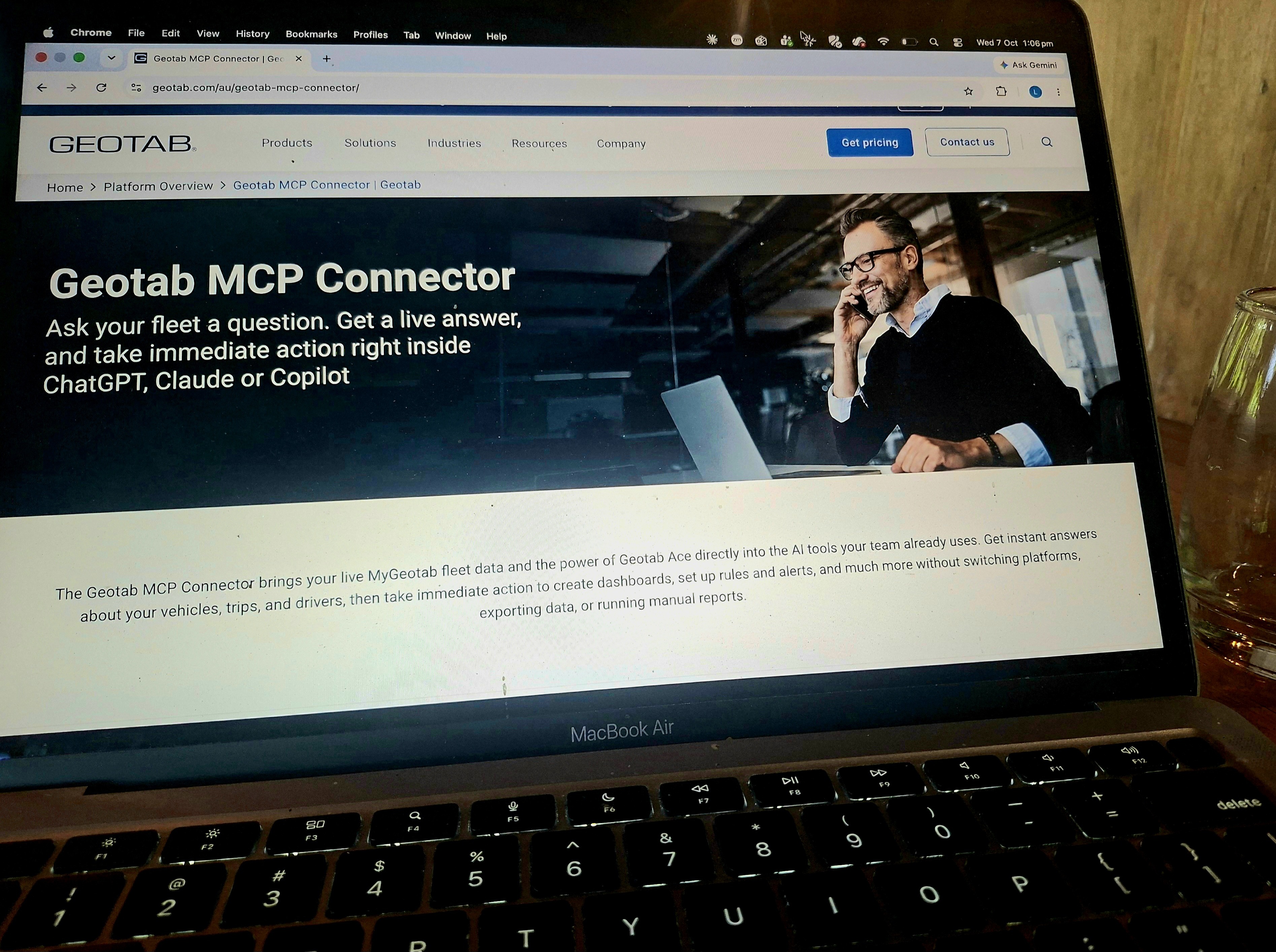
What Geotab's MCP connector actually does
Geotab has done something genuinely useful here. Its new Model Context Protocol (MCP) connector lets you type a plain English question inside a tool like Claude, ChatGPT or Microsoft Copilot, and get an answer straight out of your MyGeotab account, without opening a report or waiting on IT. As a Geotab partner working in this data every day, we think it's one of the more practical AI releases we've seen from a telematics provider, and it's worth understanding properly.
Model Context Protocol, or MCP, is an open standard governed by Agentic AI Foundation, that lets an AI tool connect into another piece of software without anyone writing custom integration code for it. It's what makes it trivial to connect a tool like Claude into a system that would otherwise need a bespoke integration. Geotab isn't the only provider adopting it, MCP is becoming an industry-wide standard, but its version means Geotab customers can now open a normal AI chat window, ask about their fleet the way they'd ask a colleague, and have the AI go and get the answer itself.
That's already a genuinely useful capability on its own. What we want to add, as a team that spends its days in fleet data, is a clear picture of the technology and the best business cases for it, and a clear picture of where a different tool does the job better.
An example: asking who our worst drivers were
We put this to the test on our own fleet. With the Geotab MCP connector added to Claude, we asked a single plain English question: who have been the safest drivers across our fleet over the past month.
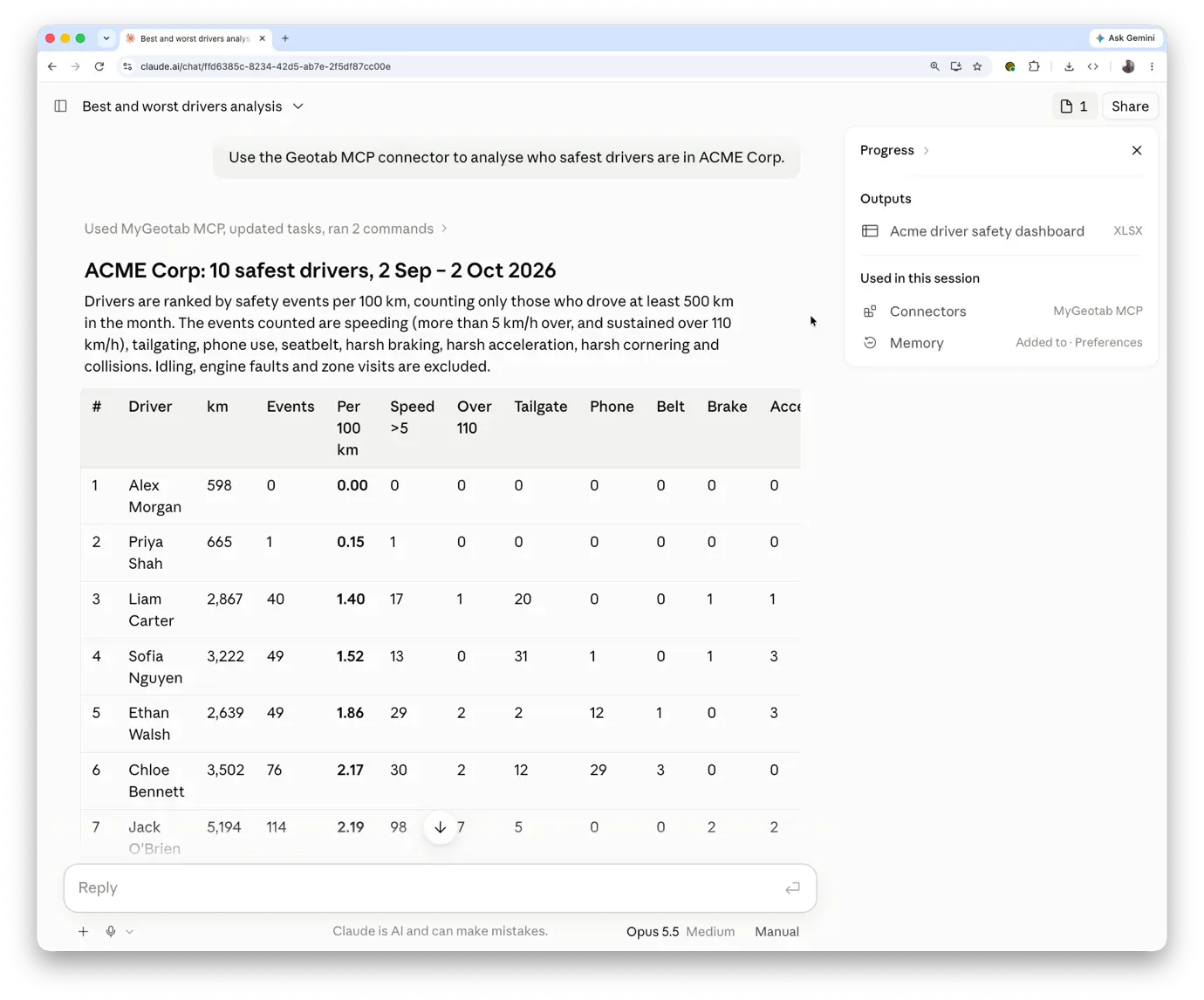
Behind the scenes, Claude logged into Geotab using our own credentials and permissions, then built the equivalent of a report from scratch: pulling vehicle data, deciding what SAFEST should mean, and checking harsh braking and speeding events.
One nuance worth knowing if you try this yourself: our answer came back attributed to vehicles rather than drivers. It's a good example of how to get the most out of the connector, the more precisely you frame the question, the more precisely it can answer, since "worst driver" and "worst vehicle" pull from different parts of the data model.
This is exactly where MCP earns its place: an ad hoc, fairly complex question we didn't already have a report for. Rather than opening Geotab and building a query by hand, we asked and got an answer in the same window we were already working in. That's the sweet spot for this kind of tool: questions that come up occasionally, change shape each time, and don't justify building a permanent report.
Getting the most value: when to ask, and when to automate
That query took around 2.5 minutes to run, and burned a meaningful number of tokens, because Claude had to work out how to answer it from scratch: query the data, test its own logic, get it wrong, adjust, and try again. A report built once to answer that same question would run in about 2 seconds, with no ongoing token cost at all.
"MCP isn't the answer to everything, but it's a great tool in the toolbag. Where the requirements are fuzzy, or you don't yet know exactly what you want out of the data, it's the fastest way to figure that out." says Dan, CEO of Zetifi
That's the real decision fleet teams now face. A one-off, oddly shaped question is a good reason to reach for an AI query. A question you'll ask again and again, in more or less the same shape, weekly safety reporting, driver scorecards, maintenance due dates, is a good reason to build it once as an automation and stop paying for it every time.
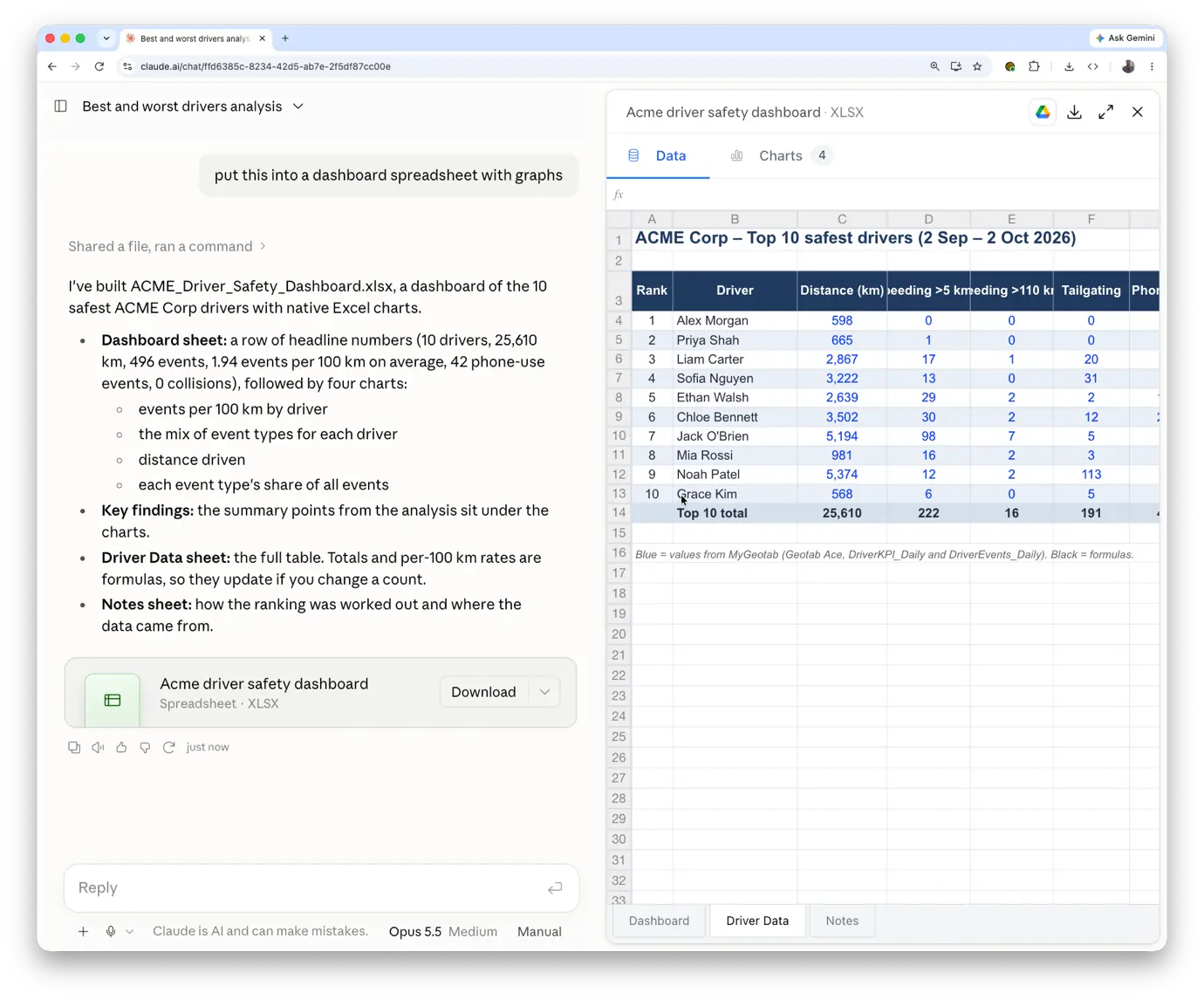
This is where Zetifi Marshal picks up. An AI query is run by one person, against whatever data that person's own login can see, in that moment. Most fleet businesses need something that keeps working for everyone, in the background, without a person typing questions into a chat window. Marshal pulls together the information sitting in Geotab, or whatever other systems a business runs on, and stores it inside that business's own Microsoft environment, ready for Power Automate and Power BI to turn into reliable, repeatable workflows, not just answers you have to ask for one at a time.
Geotab's MCP connector is a genuinely useful tool, and it's only going to get more capable. Knowing when to reach for it, and when to reach for something built to run on its own, is what actually determines whether AI saves a fleet team time or quietly costs it more.