A version of this article, edited and expanded by Farming Ahead, was published on Farming Ahead.
Farmers’ relationship with technology is often misunderstood. Like most business owners and leaders, they are rational about adoption. They move when the return is proven, and not before.
That discipline has produced a clear order of adoption on Australian farms. Satellite guidance and autosteer are mainstream. Telematics and asset tracking are crossing into the mass market now. Connected fleet safety is close behind them. Technology that protects people working alone sits a step further back again, still with the early adopters.
The interesting part is what that order means for the operators at the front of it. Every layer on this ladder runs on the same foundation: connectivity, and a way to make sense of the data that comes back over it. Once a farm has paid for that foundation out of fuel and asset savings, the cost of adding the safety layer on top of it is marginal. The return compounds on a single investment. That is why safety is next, and why it will arrive faster than the layers before it did.
Why farmers wait for the numbers
A survey of technology use on farms found that farmers invest in new tools “when they perceive that benefits exceed costs”. Conversely, uncertainty about the benefit is what holds adoption back. That’s not resistance to technology. It’s discipline.
The reason for that discipline is arithmetic of a different kind. A farmer might get 50 chances to plant a successful seasonal crop across an entire career. With so many variables already in play, small changes carry significant consequences for yield. To knowingly introduce another variable through a technology investment, a farmer has to be close to certain it will pay.
When it is certain, adoption follows quickly. Government figures show “cropping industry productivity growth has outpaced the livestock industries”, in part because of technology adoption and improvements in management practices.
Autosteer set the pattern
GPS-guided equipment now accounts for around 80 percent of the value of all the digital technology on an Australian grain farm, and the reason is arithmetic. One grower in a GRDC case study measured the input savings from reduced overlap alone at $7.24 a hectare across 900 hectares, before counting the reduction in operator fatigue through seeding and harvest. Scale that across the sector and the prize is national.
Farmers didn’t adopt autosteer because it was clever. They adopted it because the maths worked. Every layer since has had to clear the same bar.
Telematics is clearing that bar now
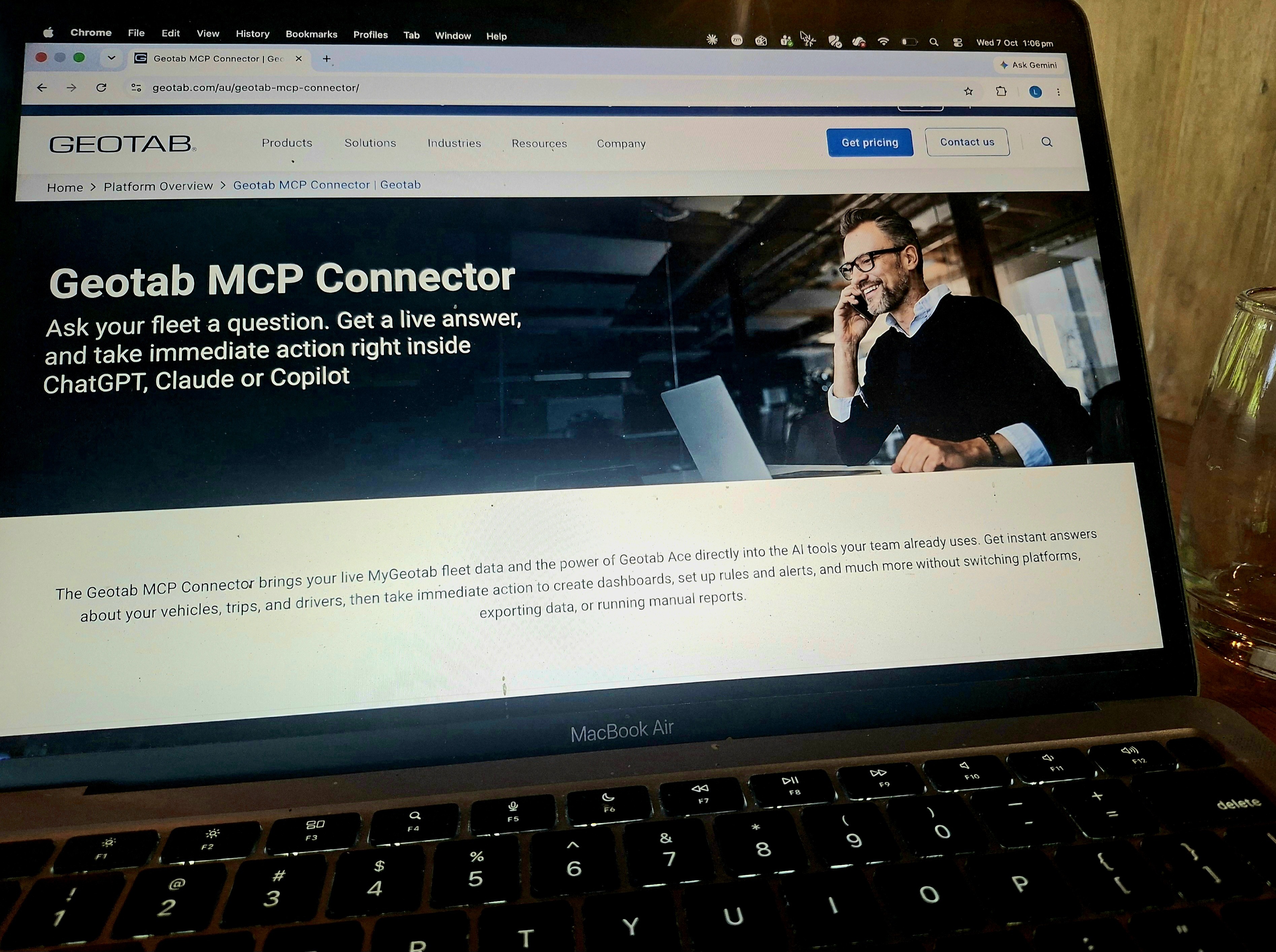
Telematics and asset tracking sit a step behind autosteer and are crossing into the mass market for the same reason. The return has become hard to ignore.
The value is not in knowing where vehicles and machinery are. It is in knowing how they are being used: where it drives, how hard it works, how long it sits idling. Fuel is a top-line (and topical) cost and a diesel engine left idling can burn around three litres an hour doing no work at all. Telematics makes that waste visible, and better driving with less idling can save 3 to 6 percent of fuel. On a serious fuel bill, a few percent is real money.
Depreciation is the larger and less visible cost. Farm machinery depreciates for every hour on the clock, whether or not the machine is doing anything useful with that hour, and on a modern fleet that is a substantial number few operators are actively managing. Telematics produces the raw data to track it. Turning that data into a decision means analysing it in the context of the farming operation, which is where investment is now being directed, with a view to giving farmers real-time notifications and actions they can take to optimise fleet performance.
That same data stream also supports safer driving. Detecting harsh acceleration, braking, cornering and distracted driving pays through fewer crashes and lower claims, particularly on larger enterprise-run farms.
Note the shape of what has just happened. A farm that installed telematics for fuel and asset reasons has now paid for a connected vehicle, a data path off the property, and an analytics layer to make sense of what comes back. The safety application arrives on top of infrastructure that has already justified itself.
Coverage is the foundation the whole ladder stands on
None of it works without connectivity. A duress alert or a check-in only returns something if it works where the person actually is. A safety feature that cannot send its signal from the back paddock has a return of zero. The same is true of telematics: data that cannot leave the paddock is not data anyone can act on.
For anything safety critical, one channel is not enough either. A phone on its own is a single point of failure, and that holds even on the rare patch of ground where it carries a bar of signal. A duress call needs to be able to fall back from the mobile network to a dedicated device, to UHF, to whatever will carry it.
This is the part that’s easy to underestimate and expensive to retrofit. It is also the part that, once solved, is shared by every layer above it.
Lone worker safety is where agriculture becomes the early adopter
Protecting people who work alone is the layer still in the early-adopter phase, and it is where the compounding return is clearest.
Start with the money, because that is the test every other layer had to pass. One study found every dollar invested in workplace safety returns about $2.20, a better return than most capital a farm will ever buy. The downside it avoids is not small either: the median serious workers’ compensation claim in Australia costs $14,400 and 7.2 weeks of lost time, before counting the disruption to a business already short of labour.
Then add the part that is specific to this moment. Unlike autosteer or telematics, most of the enabling infrastructure is already installed. The vehicle is connected. The data path exists. The marginal cost of the safety layer is a fraction of what it would have been as a standalone purchase, which means it clears the ROI bar on numbers that wouldn’t have worked five years ago.
Risk and liability reinforce it. Agriculture still carries a high worker fatality rate, with 72 on-farm deaths recorded in 2024, more than double the year before. Australian work health and safety law already requires a business to manage the risks of remote or isolated work, and to provide a system of work that includes effective communication with the worker. On a farm, where people routinely work out of sight and out of range, that duty is not theoretical.
Mining and heavy transport learned all of this through hard experience. Agriculture is starting the same journey, with forward-thinking operators moving first, and the options are improving quickly.
Come back to the 50 seasons. A career in this industry is a finite number of chances to get it right, which is exactly why farmers are so careful about what they invest in. It is also why the safety layer belongs on the list. The point of it is making sure the operator is there for all 50. That is not a grudge purchase. It is avoided cost, on a risk that in this sector is real and rising.
The mistake to avoid is overbuilding
The opportunity here is layered, but it does not have to be complicated. The most common mistake is buying a new system for every new problem, which multiplies cost, training and administration for returns that were supposed to compound.
Zetifi Marshal is built the other way around. It is API-first and Microsoft-native, so it works inside the tools a business already runs and connects to the telematics platform already in the vehicle. You don’t need another platform. The same setup that recovers fuel and protects an asset can also watch over the person operating it, and the returns compound on a single investment.
That is the argument for moving now rather than waiting for this layer to become mainstream. The farms at the front of the curve are not taking a risk on unproven technology. They are getting a second return on infrastructure they have already bought.