
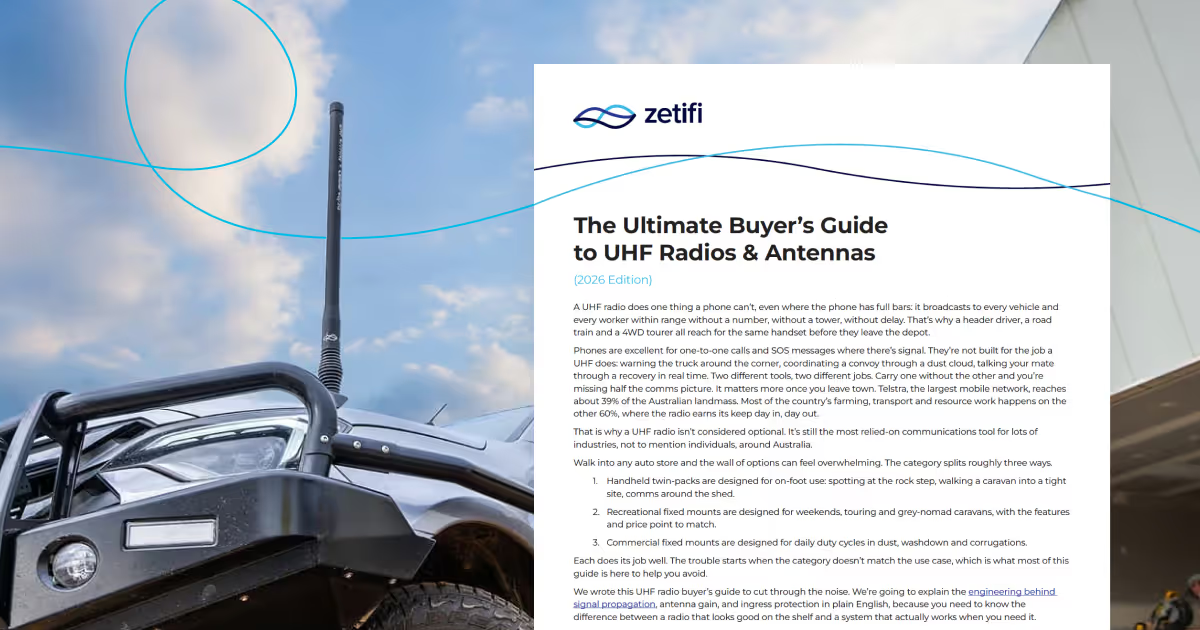
A UHF radio does one thing a phone can't, even where the phone has full bars: it broadcasts to every vehicle and every worker within range without a number, without a tower, without delay. That's why a header driver, a road train and a 4WD tourer all reach for the same handset before they leave the depot.
Phones are excellent for one-to-one calls and SOS messages where there's signal. They're not built for the job a UHF does: warning the truck around the corner, coordinating a convoy through a dust cloud, talking your mate through a recovery in real time. Two different tools, two different jobs. Carry one without the other and you're missing half the comms picture. It matters more once you leave town. Telstra, the largest mobile network, reaches about 39% of the Australian landmass. Most of the country's farming, transport and resource work happens on the other 60%, where the radio earns its keep day in, day out.
That is why a UHF radio isn't considered optional. It's still the most relied-on communications tool for lots of industries, not to mention individuals, around Australia.
Walk into any auto store and the wall of options can feel overwhelming. The category splits roughly three ways.
- Handheld twin-packs are designed for on-foot use: spotting at the rock step, walking a caravan into a tight site, comms around the shed.
- Recreational fixed mounts are designed for weekends, touring and grey-nomad caravans, with the features and price point to match.
- Commercial fixed mounts are designed for daily duty cycles in dust, washdown and corrugations.
Each does its job well. The trouble starts when the category doesn't match the use case, which is what most of this guide is here to help you avoid.
We wrote this UHF radio buyer's guide to cut through the noise. We're going to explain the engineering behind signal propagation, antenna gain, and ingress protection in plain English, because you need to know the difference between a radio that looks good on the shelf and a system that actually works when you need it.
Why You Need a UHF Radio in 2026
A UHF radio (Ultra High Frequency) doesn't rely on a tower. It connects you directly to the people near to you, works when the power grid goes down, and reaches into the bottom of a gorge where 4G signals can't go. Reliable communication is just as vital as fuel, water, and your suspension setup whether you're planning to work safe or planning a Big Lap.
- Farmers use UHF CB to coordinate headers so they don't collide in the dust.
- Truckies use it to warn about oversized loads on Channel 40.
- 4WD tourers use it to call for a recovery when a diff snaps.
Think of your radio like PPE. You wouldn't wear thongs to a mine site. Don't head into remote areas without a UHF.
The Connectivity Gap
Cellular and satellite are getting better fast. A Cellular Smart Antenna can drag a usable 4G/5G signal in from the horizon, and Starlink has changed the game for people who live or work in remote areas. These are excellent tools, but they aren't a substitute for UHF CB, because UHF does a different job.
That job is one-to-many broadcast at zero latency. Push the button and every vehicle or person with a UHF in range on your channel hears you. No number to dial, no tower to find, no satellite hop. The road train coming the other way is already on Channel 40. So is the grader at the work-site entrance. Phones connect two people who already know how to find each other. UHF connects everyone in your vicinity, which is the only way to reach them when you don't know who's out there yet.
Handheld vs. Fixed Mount: Which is Right for You?
The Limits of Handhelds
Handheld UHF radios have their place. They're great for camping (especially for the kids), perfect for reversing a van or spotting someone up a rock step, hiking on foot away from camp or for communicating around a site. A 5-watt handheld is essential kit for when you leave the cab, but inside the vehicle its performance can't match what you will get out of a dedicated mobile unit (on that, it can be confusing that a fixed mount in vehicle radio is also known as a mobile radio, it comes from the days of base station radios back at the house, but it is still commonly used to describe in vehicle radios.)
The Faraday Cage Effect
Your vehicle is a steel cage. Metal blocks radio waves, which is the simple physics behind the "Faraday Cage" effect. Try to transmit with a handheld inside the cab and the signal bounces off the pillars and roof, struggling to push out through the glass. Typical in-cab range loss from a handheld is on the order of 50% or more, so a 5 km unit can easily drop to 1–2 km.
Then there's the volume problem. A tiny hand piece speaker can't compete with a diesel engine, mud-terrain tyres, and the air-con blasting. You will miss the warning call.
The Fixed Mount Advantage
For long-distance touring or work, a fixed mount radio is what you need. These units bolt in and wire straight to your battery, giving you a clean, consistent 5 watts of power without the voltage drop of a dying battery pack. Battery life should never be an issue because the vehicle powers the unit. However, you will have to decide whether to wire it to accessories, or to an always-on direct-to-battery connection with a switch to stop your battery running flat. Some units, including Icom radios, have the option of wiring to an ignition switch which allows you to keep it on for a couple of hours after the vehicle is turned off.
Crucially, they use an external antenna. That antenna sits on your bullbar or roof, completely clear of the metal cage, with the benefit of a ground plane that helps radiate signal into open air. A fixed mount unit gives you reliable comms over 5 to 20 km. It's integrated, always charged, and always ready.
Modern Interiors: The Remote Head Solution
Modern 4WDs like the LandCruiser 300 Series or Ford Ranger have dashboards cluttered with touchscreens and not much room for a traditional DIN-sized radio box. Remote head units solve this neatly. The "brains" of the radio are hidden away under the seat or behind the dash, and all the controls, the screen, and the microphone live in the hand piece. Clean dash, full fixed radio performance.
The Secret to Range: It's All About the Antenna
If your budget is split between the radio and the antenna, weight it toward the antenna. The radio generates the signal; the antenna radiates it. A high-end radio with an average antenna will underperform a basic radio paired with a well-matched one.
Understanding Antenna Gain: The Torch Analogy
Antenna gain is measured in dBi. "6dBi HIGH GAIN" gets prominent billing on plenty of boxes, but gain doesn't create power, it focuses it. Think of gain like a torch with an adjustable beam: same battery, just a wider or narrower throw.
High Gain Antennas (6dBi+): The Spotlight
- The Shape: A flat, tight pancake of signal. It goes a greater distance but has no height.
- Best For: Flat terrain. The Hay Plain, the Nullarbor, dead-flat highways.
- The Catch: Hit a hill, and that flat beam smacks into the dirt. Tilt your 4WD on a track, and you're shooting signal into space or the ground.
Low Gain (2dBi): The Lantern
- The Shape: A big, round ball of signal. Short reach, but it goes up and down.
- Best For: Blue Mountains, city canyons.
- The Benefit: It climbs out of valleys and talks over ridges. It doesn't care if your vehicle is on a lean.
Medium Gain (3dBi – 5dBi): The Floodlight
- The Shape: A balance. Decent reach, decent height.
- Best For: Most outback travel, scrub country, the Mallee.
- The Reality: A medium-gain antenna is the "set and forget" option for most drivers.
Terrain Dictates Performance
In the high country, if you're in a valley and your mate is over the hill, high gain fails. The narrow beam puts almost no energy at the elevation angles you need to clear the ridge. You need low gain there, where the broader lantern pattern radiates enough power upward and outward to diffract over the hilltop and bounce off the surrounding terrain, working beyond visual line of sight.
For years the solution was carrying two antennas, a short fat stick for hilly terrain and a long fibreglass whip for the flats. Supposedly you'd stop, get out, unscrew the aerial, and swap it over. In reality nobody did that. Drivers left the long whip on because it looked good, drove into the hills, and lost signal.
The Zetifi Solution: One Antenna for All Terrains
Most people won't swap antennas when the terrain changes. So Zetifi built one that doesn't need to.
Zetifi's 3dBi UHF CB Antenna sits in the sweet spot. It gives you the vertical spread needed for hills, tracks and real-world driving, without sacrificing everyday range. One antenna, no guesswork, no swapping.
Everything comes in the pack. No chasing mounts, cables or extras to make it work. It's designed to go straight onto your vehicle and get you connected properly from day one.
It's also built for modern vehicles. Low-profile, bonnet-friendly, matte black finish to reduce glare, and an award-winning design that actually looks like it belongs on a new ute, not bolted on as an afterthought.
The antenna itself is made in Australia and built for harsh conditions. It's IP69K rated against dust and water, backed by a 5-year warranty, and supported by a 90-day performance guarantee. But it doesn't just look good on paper. Zetifi tested it over 100,000 km across our Aussie outback, to ensure it's rugged enough to handle real use.
Why We Chose Icom for the Zetifi UHF Pack
Australia has three top-tier UHF radio brands working in this market: GME, Uniden and Icom. Each brings a different specialisation. GME is Australian-owned and Australian-made, with strong local support and the XRS Connect range widely used across touring, 4WD and caravan. Uniden is a global consumer electronics company with decades of radio engineering behind it. Both are top brands in the categories they serve, and for many buyers they're the right call.
Icom is a Japanese commercial radio manufacturer that has built its product line around mine sites, government fleets, marine, aviation and emergency services for decades. That's the segment Zetifi specialises in too: our customers run commercial and industrial fleets, often with integration requirements like radio-to-telematics handoffs, multi-vehicle coordination, and ruggedised installations. Icom's range is designed for that work, which is why we partnered with them for the Zetifi UHF Pack. It's an alignment of specialisation between Icom and Zetifi, not a quality judgment on the alternatives.
The Icom IC-455 in our pack is a commercial-grade tool that brings the DNA of Icom's military and aviation radios into your ute. Active Noise Cancelling listens to engine roar and road noise then deletes it digitally, so the other person hears you and not your tyres. Voice Recording lets you replay missed calls, which is essential when instructions are flying fast. It's built to MIL-STD 810G for shock and vibration and carries IP54 ingress protection on the head unit. In practice, it's designed to handle years of daily duty cycles in heat, dust and vibration. Icom backs it with a 5-year warranty.
Our kit pairs this industrial Icom unit with the Zetifi Smart Antenna. You get the intelligence, including app connectivity and GPS-based terrain adaptation, in the antenna, and the reliability in the radio. They're designed to work together.
Installation: Getting It Right
A poor install undoes the work of a good radio. RF physics is predictable, so most install mistakes are avoidable once you know what to look for. Need a hand? Find a certified installer near you.
Mounting Location: Bullbar vs. Roof vs. Bonnet
The Roof
Technically, the centre of the roof is king. It gives a perfect 360-degree signal pattern and height equals range.
Pro: Maximum performance.
Con: You'll smack the aerial on every car park ceiling and low branch.
The Bullbar
The bullbar is the Aussie standard for good reason. It's a compromise, but a practical one.
Pro: Protects the antenna, easy to reach.
Con: The cab blocks the signal behind you.
To fix the bullbar issue, use an elevated feed antenna. This lifts the "active" part of the antenna above the bonnet line. If it sits too low, your bonnet acts like a mirror, reflecting signal back and distorting your pattern. If you're tight on space, a Combo Smart Antenna condenses UHF and cellular onto one mount and keeps things tidy.
The Bonnet
A clean, modern mounting option that's becoming more common on newer vehicles. It sits low and off to the side, keeping things discreet.
Pro: Out of the driver and passenger line of sight, neater look on modern vehicles, less risk of hitting car parks or low branches. Installation is simple and doesn't require roof access.
Con: Lower mounting height can reduce range compared to roof setups. The vehicle body can also cause some signal shadowing depending on placement.
To get the best performance from a bonnet mount, use an elevated feed antenna to lift the active element above the bonnet line and minimise signal reflection. This helps maintain a more consistent signal pattern and improves overall performance for everyday use.
Rule of thumb: Whichever you choose, get the tip of the antenna above the roof line.
Cabling and Power
Power Supply: Go straight to the battery.
- Use fused cables on both positive and negative.
- Never use the cigarette lighter circuit. It's "dirty" power full of alternator whine and interference.
Coax Cable Management
- Don't Coil It: Coiling excess cable creates an RF choke. It strangles the signal strength.
- Figure-Eight: If you have slack, lay it in a loose figure-eight pattern.
- Watch the Firewall: Use a grommet. If the cable rubs on metal, water gets in, wicks up the copper, and rots your cable from the inside out.
Ground Planes
Antennas need something to push against, which is typically your vehicle's metal body. Ground-dependent antennas like magnetic base units need that metal contact to work properly. Zetifi antennas are ground independent with the counterpoise built in, so you can mount them on a tab, a mirror bracket, or a composite bar and they perform fine. Mounting on a solid metal bar still helps shape the signal forward, though, so it's worth it if the option is there.
Durability: Why IP67 Is Not Enough
Most recreational antennas are rated to IP66 or IP67. IP67 means the unit handles immersion in 1 m of water for 30 minutes, which covers the occasional creek crossing comfortably. The thing most spec sheets don't address is what comes after the crossing.
The killer is the pressure washer.
Farm utes and mine vehicles get blasted regularly to shift the red dirt. High-pressure, hot water jets can get past an IP67 seal where they can't get past an IP69K one. Once moisture is inside the housing, corrosion follows and the antenna's working life is cut short.
Zetifi antennas are IP69K certified under ISO 20653, the current standard that replaced DIN 40050-9. That means they are tested with 80°C water at 80 to 100 bar from close range, across multiple angles on a rotating turntable. In practical terms, it is built to handle the kind of pressure-washer treatment farm utes and mine vehicles see every week. We achieve this by potting the electronics, filling the base with a specialised epoxy that turns the insides into a solid block with no air gaps and nowhere for water to enter. We also use parallel fibreglass radomes that add structural stiffness so the vibration of 100,000 km of corrugations doesn't crack the circuit board.
If your work environment includes weekly pressure washing or daily dust, IP69K is the rating to look for. IP67 will do for occasional touring and the odd creek crossing, but it isn't designed to hold up against routine washdowns over years.
Essential UHF Channels and Etiquette
The UHF band is shared infrastructure. It works because operators keep it clean. A handful of channels are reserved for specific jobs, and the etiquette is straightforward.
- Channel 40 (Highway): The lifeblood of Australian transport. Truckies, pilot vehicles, and travellers all monitor this channel. Keep it on at all times on the open road.
- Channels 5 & 35 (Emergency): Strictly emergency only. Misuse attracts serious fines from the ACMA.
- Channel 10 (4WD): The classic club convoy channel.
- Channel 18 (Caravans): Used by grey nomads to communicate with trucks they're overtaking. "Truckie, can I slip past?"
- Channels 22 & 23 (Data): Reserved for automated data and telemetry traffic, like weather stations, water-level sensors and remote monitoring. Voice traffic on these channels interferes with that, so stay off.
- Repeater Channels 1 to 8 and 41 to 48 (Output), 31 to 38 and 71 to 78 (Input): Use these to extend your signal range via a repeater tower when in range.
Privacy Codes and Digital Features
CTCSS and DCS codes are marketed as "privacy codes," but they aren't private. Anyone can still hear you. But setting a code stops you from hearing them. It works by opening your squelch only when it detects the matching tone, which is useful for a convoy in a busy area where you want to filter out background chatter.
Outside the CB band, licensed commercial UHF apparatus can run digital protocols like DMR Tier II for cleaner audio and text messaging; relevant if you're spec'ing a private fleet channel, not UHF CB itself.
Regulatory Compliance
You don't need a licence for UHF CB in Australia. The ACMA administers a Class Licence that covers all users on the standard 80 channels — no registration, no fee.
But your gear must be legal.
- Look for the RCM: The Regulatory Compliance Mark confirms it meets Australian standards. (The older C-tick mark was retired in 2016.)
- 80 Channels, narrowband: Go for an 80-channel narrowband (12.5 kHz) unit. Older 40-channel wideband (25 kHz) radios are still legal on channels 1–40 under the 2025 class licence, but you lose half the channel capacity and can experience volume/distortion artefacts when mixing with narrowband traffic.
- 5 Watt Limit: That's the legal maximum for UHF CB (476.4125–477.4125 MHz). Higher-powered radios (up to 25 W) operate on commercial frequencies that require an apparatus licence.
Maintenance and Troubleshooting
UHF systems are tough, but vibration destroys everything eventually.
1. The "Wiggle Test"
Grab the antenna. Shake it. If the bracket moves, tighten it. A loose bracket kills your ground connection and makes you sound crackly.
2. Check the Coax
Look at the cable where it feeds through the bullbar or firewall. If the black insulation is rubbed through, replace the run. Once copper is exposed, moisture wicks along the braid and degrades the signal path from the inside.
3. SWR Check
Standing Wave Ratio. It measures if your antenna is actually radiating power or reflecting it back into the radio. High SWR blows up radios. Get a tech to check it once a year.
FAQ: Your Questions Answered
What is the best UHF radio in Australia?
It depends on your needs. For a recreational tourer who wants apps and Bluetooth connectivity, GME is a common and reasonable choice. For remote travel where audio quality and reliability matter in farming, mining, or long-haul driving, we back the Icom IC-455 paired with a Zetifi Smart Antenna. The recreational brands aren't bad; they're just built for different conditions.
Which is better, Oricom or Uniden?
Both sit in the same segment at similar price points and in our testing they perform comparably. For touring, 4WD use and the occasional outback trip, either is a solid choice. For environments with heavy washdown, daily duty cycles or commercial-grade audio requirements, we'd look at a commercial-grade unit like the Icom IC-455 instead.
Do you need a licence for a UHF radio in Australia?
No. The UHF CB Class Licence from the ACMA covers all users on the standard 80 channels. No registration, no fee, provided you use approved equipment with the RCM mark, transmit at or below 5 watts, and stay off the emergency channels (5 and 35) unless you're in genuine distress.
What range can I expect from a UHF radio?
Physics limits UHF range. Vehicle-to-vehicle on open flat terrain with a good external antenna, expect 10 to 20 km. In hilly terrain or dense bush, expect 2 to 5 km. Repeater stations can extend this to 50 km or more. A handheld inside a vehicle without an external antenna will give you maybe 1 km, which is why we keep coming back to the fixed mount setup with a proper external antenna.
Is Icom a good brand?
Icom is the global commercial standard for professional radio communications. Emergency services, military organisations, and humanitarian operations around the world rely on Icom equipment. Their UHF CB range brings that same engineering discipline into the cab of a ute. Yes, they're a good brand.
Do people still use CB radios in 2026?
Absolutely. In remote areas without mobile coverage, they're the only way to communicate vehicle-to-vehicle. They're essential for safety on highways, mine sites, and farms. Channel 40 is alive and active every day across regional and outback Australia. The ACMA updated the Class Licence in 2025 to allow internet-linked CB networks, which shows the system is expanding, not phasing out.
Why UHF rather than VHF?
VHF (Very High Frequency) is used for marine radio and certain commercial land mobile networks. UHF was allocated for Australian citizen-band use because it offers more available channel capacity, supports convenient antenna sizes (a quarter-wave at 477 MHz is about 16 cm), and performs well in built-up and multipath environments. VHF propagates further over open water and through dense vegetation, which is why marine services use it, but UHF wins for land-based vehicle comms in the conditions Australian drivers actually face.
Are magnetic base antennas any good?
They're convenient for temporary use on rental vehicles or borrowed cars. The problem is they require a metal roof to function as a ground plane, they scratch paint, and the cable routing through the door seal usually leads to water ingress or cable damage down the track. For any vehicle you own and drive regularly, a fixed mount is worth doing properly.
The Bottom Line
Out of mobile coverage, you're on your own for comms. That's a planning question, not a luck question.
When you leave the bitumen, you're responsible for your own comms. A phone covers one-to-one calls and SOS where there's signal. A UHF covers vehicle-to-vehicle and work-to-work whether there's signal or not. You need both. The piece you can't do with a phone is the one most people skip, and the wrong UHF setup — a recreational antenna that gives up after the first washdown or a handheld trapped inside a steel cab — is what leaves people short.
Match the gear to the job. For touring weekends and the occasional outback trip, a recreational fixed mount with a quality antenna will cover most of what you need. For daily work in heat, dust, washdown and corrugations, a commercial-grade fixed mount paired with an IP69K antenna is the setup that holds up over years of daily duty. A 3dBi antenna that performs across both flat and hilly terrain means one install, no swapping.
The Zetifi + Icom pack is built around the reality of Australian commercial operations: commercial-grade Icom audio and build, paired with a terrain-adaptive, ground-independent, IP69K antenna with a 5-year warranty. One install, no antenna-swapping, no washdown anxiety.
It isn't just an accessory. It's the one tool a phone can't replace.
Find a Dealer | Shop the Zetifi + Icom UHF Pack