This is Part 1 of 5 in Zetifi's UHF Blog Series — The Ultimate Buyer's Guide to UHF Radios & Antennas (2026 Edition). Whether you're a truckie, farmer, or serious 4WD tourer, this series covers everything you need to choose, install, and get the most out of your UHF setup in the Australian outback.
A UHF radio (Ultra High Frequency) doesn't rely on a tower. It connects you directly to the people near to you, works when the power grid goes down, and reaches into the bottom of a gorge where 4G signals can't go. Reliable communication is just as vital as fuel, water, and your suspension setup — whether you're planning to work safe or planning a Big Lap.
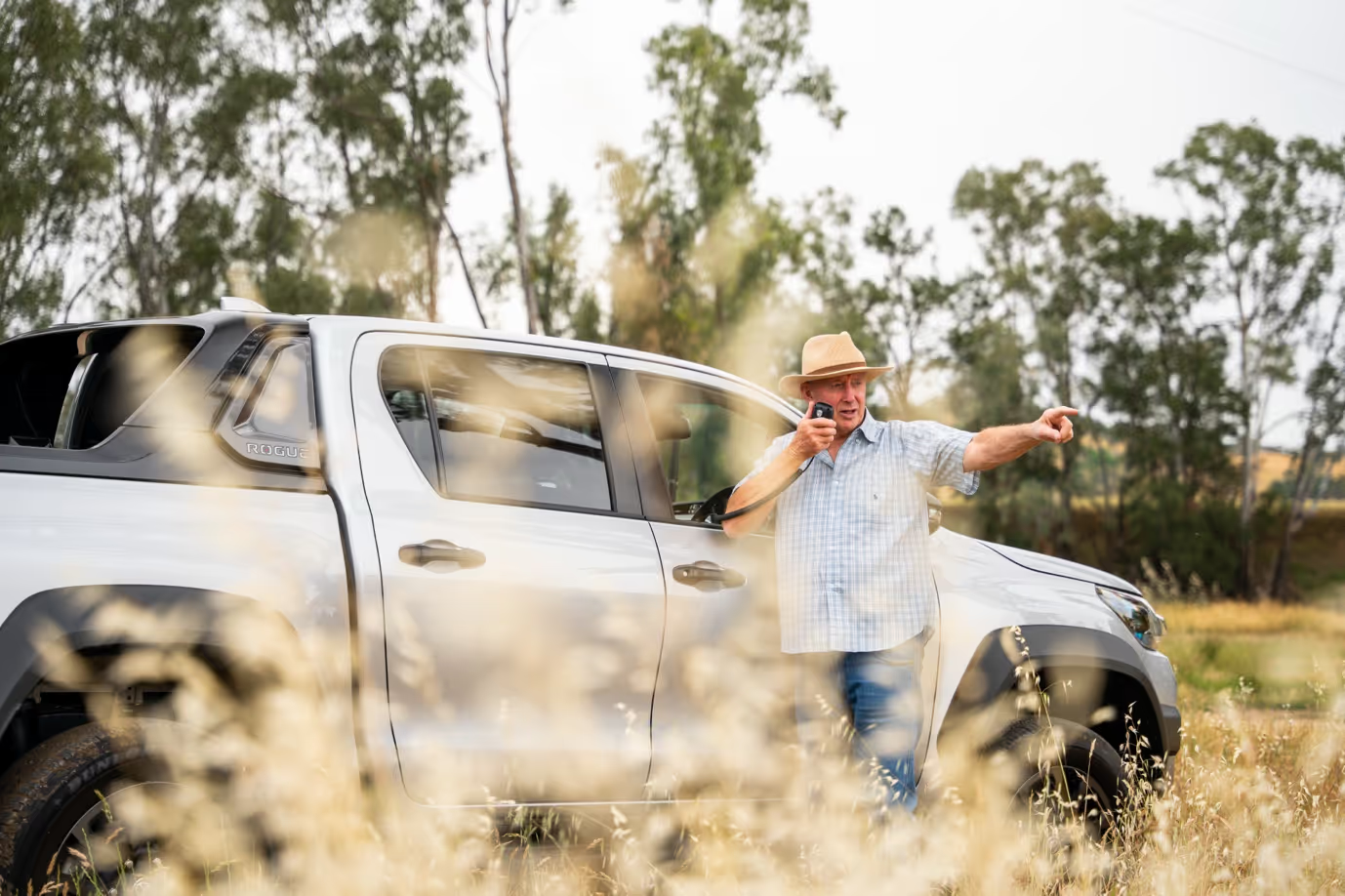
- Farmers use UHF CB to coordinate headers so they don't collide in the dust.
- Truckies use it to warn about oversized loads on Channel 40.
- 4WD tourers use it to call for a recovery when a diff snaps.
Think of your radio like PPE. You wouldn't wear thongs to a mine site. Don't head into remote areas without a UHF.
The Connectivity Gap
Cellular and satellite are getting better fast. A Cellular Smart Antenna can drag a usable 4G/5G signal in from the horizon, and Starlink has changed the game for people who live or work in remote areas. These are excellent tools, but they aren't a substitute for UHF CB, because UHF does a different job.
That job is one-to-many broadcast at zero latency. Push the button and every vehicle or person with a UHF in range on your channel hears you. No number to dial, no tower to find, no satellite hop. The road train coming the other way is already on Channel 40. So is the grader at the work-site entrance. Phones connect two people who already know how to find each other. UHF connects everyone in your vicinity — which is the only way to reach them when you don't know who's out there yet.
Find out more about Channel 40 in: Essential UHF Channels and Etiquette
FAQ: Your Questions Answered
What is the best UHF radio in Australia?
It depends on your needs. For a recreational tourer who wants apps and Bluetooth connectivity, GME is a common and reasonable choice. For remote travel where audio quality and reliability matter in farming, mining, or long-haul driving, we back the Icom IC-455 paired with a Zetifi Smart Antenna. The recreational brands aren't bad; they're just built for different conditions.
Which is better, Oricom or Uniden?
Both sit in the same segment at similar price points and in our testing they perform comparably. For touring, 4WD use and the occasional outback trip, either is a solid choice. For environments with heavy washdown, daily duty cycles or commercial-grade audio requirements, we'd look at a commercial-grade unit like the Icom IC-455 instead.
Do you need a licence for a UHF radio in Australia?
No. The UHF CB Class Licence from the ACMA covers all users on the standard 80 channels. No registration, no fee, provided you use approved equipment with the RCM mark, transmit at or below 5 watts, and stay off the emergency channels (5 and 35) unless you're in genuine distress.
What range can I expect from a UHF radio?
Physics limits UHF range. Vehicle-to-vehicle on open flat terrain with a good external antenna, expect 10 to 20 km. In hilly terrain or dense bush, expect 2 to 5 km. Repeater stations can extend this to 50 km or more. A handheld inside a vehicle without an external antenna will give you maybe 1 km — which is why we keep coming back to the fixed mount setup with a proper external antenna.
Is Icom a good brand?
Icom is the global commercial standard for professional radio communications. Emergency services, military organisations, and humanitarian operations around the world rely on Icom equipment. Their UHF CB range brings that same engineering discipline into the cab of a ute. Yes, they're a good brand.
Do people still use CB radios in 2026?
Absolutely. In remote areas without mobile coverage, they're the only way to communicate vehicle-to-vehicle. They're essential for safety on highways, mine sites, and farms. Channel 40 is alive and active every day across regional and outback Australia. The ACMA updated the Class Licence in 2025 to allow internet-linked CB networks, which shows the system is expanding, not phasing out.
Why UHF rather than VHF?
VHF (Very High Frequency) is used for marine radio and certain commercial land mobile networks. UHF was allocated for Australian citizen-band use because it offers more available channel capacity, supports convenient antenna sizes (a quarter-wave at 477 MHz is about 16 cm), and performs well in built-up and multipath environments. VHF propagates further over open water and through dense vegetation, which is why marine services use it, but UHF wins for land-based vehicle comms in the conditions Australian drivers actually face.
Are magnetic base antennas any good?
They're convenient for temporary use on rental vehicles or borrowed cars. The problem is they require a metal roof to function as a ground plane, they scratch paint, and the cable routing through the door seal usually leads to water ingress or cable damage down the track. For any vehicle you own and drive regularly, a fixed mount is worth doing properly.
Up Next — Part 2: Handheld vs. Fixed Mount: Which Is Right for You?
Most drivers assume a handheld covers them. It doesn't. In Part 2 we explain why the steel cage around you is killing your signal, and what a proper fixed mount setup actually gives you on the open road.