
Zetifi UHF CB Radio Pack
Engineered for guaranteed UHF performance

One Antenna. Any Terrain.
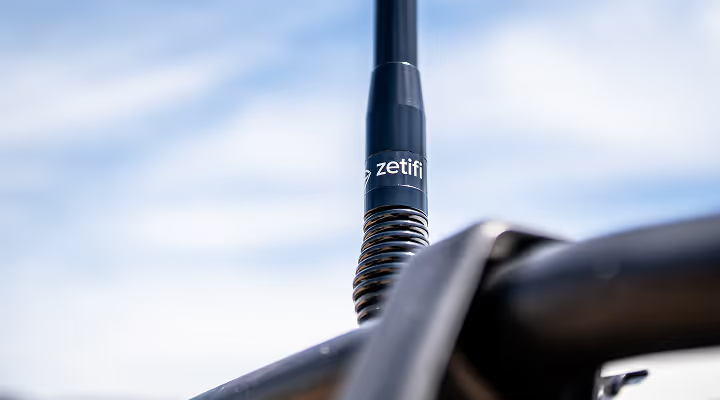
Most UHF setups force you to choose between range or terrain. This doesn’t. The Zetifi Smart Antenna is engineered for true multi-terrain performance, with a balanced 3dBi gain that works across both hilly country and open flats.
No swapping antennas. No second-guessing your setup. Just consistent, reliable signal wherever you drive. RF elements are specifically tuned for real-world conditions.
Built to Perform. Backed to Last.

90-Day Performance Guarantee
Test it in real conditions. If it doesn’t perform as expected, return it.
Proven in the Harshest Conditions
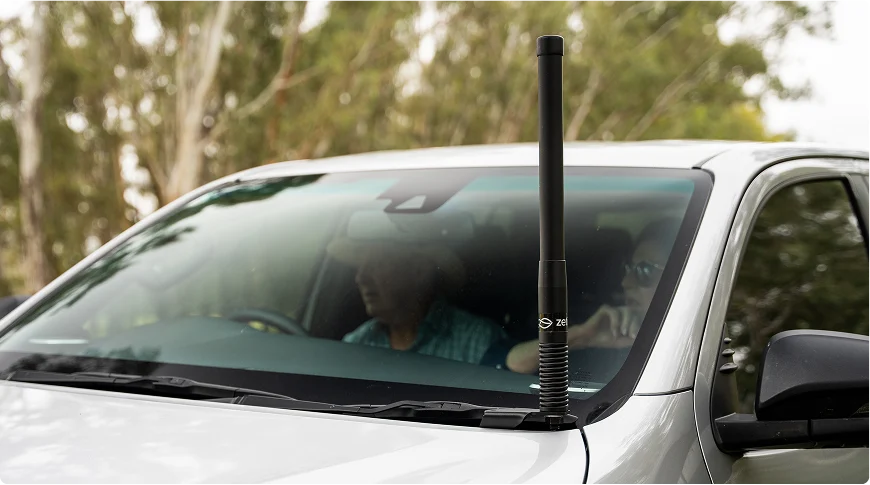
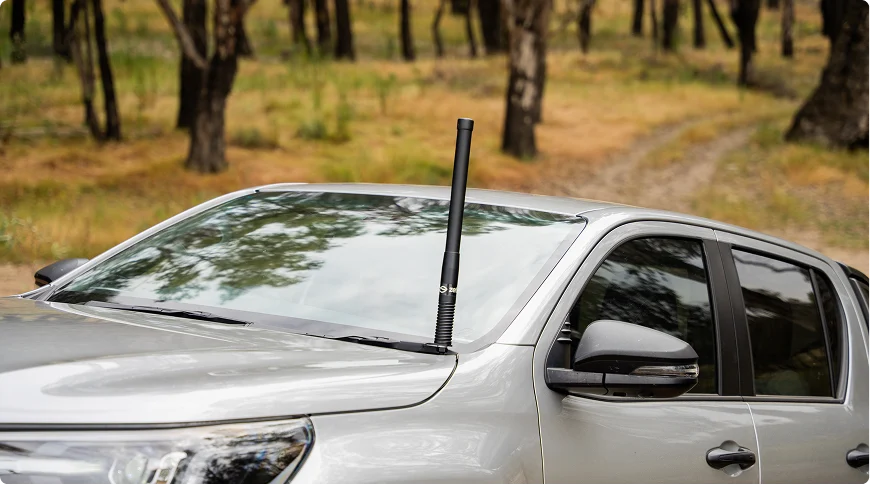
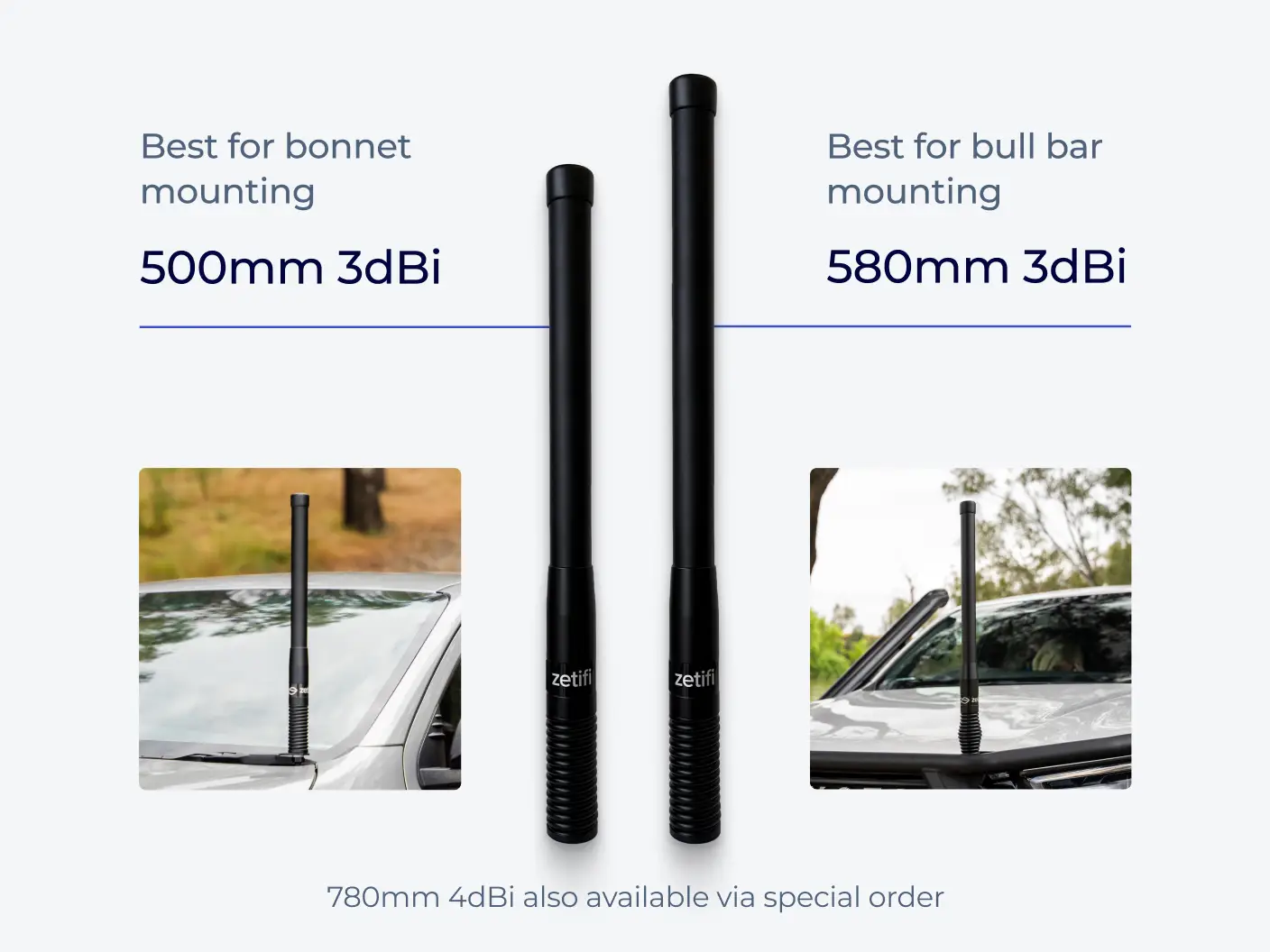
Low reflection matte black finish, two radome heights for bull-bar or bonnet mounting.

For Australian Conditions
The antenna is designed and manufactured in Wagga Wagga, with local support when you need it. Tested across real environments - not simulated ones.

Award-Winning Design
Recognised for product design and technology, the Zetifi antenna combines performance engineering with practical usability.
Read More
Built Tough Where it Matters
- IP69K rated for dust and water
- Heavy-duty spring for vibration
- Fibreglass whip for durability
- Aluminium ferrule for strength

Designed for Modern Vehicles
The 500mm antenna height is optimised for bonnet mounting, delivering strong performance without excessive height. Matte black finish matches newer vehicles & reduces light glare.
Zetifi UHF Core Antenna Technical Specifications
Every Zetifi antenna shares the same design DNA, ensuring consistent performance and reliability no matter which model you choose.
Every component is built for long-term use in harsh environments.

Lengths | 500mm or 580mm
(780mm available via special order) |
Frequencies | 477MHz |
Gain | 3dBi (3dBi for 780mm) |
Colours | Matte Black or Gloss Black |
Construction |
|
Mounting | M14 threaded stud & nut |
Coaxial cable | 4360mm LMR195 low loss coax terminated to FME male |
Warranty | 5 Years |
Rating | IP69K |
Hear what Zetifi Smart Antenna owners have to say
"The Smart Antenna from Zetifi is impressive local ingenuity… all-in-all holding phone calls while in transit over long distances is the improvement."
"Great customer service loads of help and fantastic product thanks"
"I recently purchased a Zetifi Smart Antenna to replace an aging cellular antenna for my vehicle mounted CelFi. I was a little skeptical given its a new product and I hadn’t heard anything about this before, but I thought I’d give it a go. I’m amazed at the results! I have more service in places I didn’t before, and phone calls stay connected when passing through fringe areas now. Very impressed! I’d happily recommend a Zetifi smart antenna to anyone looking to upgrade! Best of all, they’re an Australian company based in regional NSW. Thanks Zetifi!"
"Easy to install"
"Excellent product and support. Recently travelled between Orange and Canberra would’ve only been without service around 10 mins on the hole trip where previously we loss service between towns"
"Awesome"


Order yours today
World class technology to keep you connected.
*See warranty and performance guarantee terms at zetifi.com/guarantees
Related Articles

Staying alive: how technology can minimise the risks of distracted driving
This article was originally published on Safety Solutions and is republished here with permission.
Source: Safety Solutions – Staying alive: how technology can minimise the risks of distracted driving
___
Having drivers on your team who don’t keep their full attention on the road is dangerous on multiple fronts. GEORGE HOLT, Compliance Manager at Zetifi, set out how technology may be able to help.
Twiddling with the sound system, sipping on a hot or cold drink, surreptitiously scrolling or messaging on a phone… There’s a plethora of ways drivers can have their attention taken away from the road, manually, visually and mentally.
And when that happens, the chances of a road accident or incident increase significantly. So much so that distracted driving is the main contributing factor in about 16% of serious casualty road crashes, according to the Australian Automobile Association.
In recent years, mobile phones have emerged as one of the chief causes of driver distraction, here in Australia and around the world.
Taking responsibility for workers’ behaviour on the road
If one of your employees is involved in an incident or accident while they’re on the job and driving a company vehicle, it’s not only a problem for them and the individuals they’ve endangered or injured; it’s a serious risk for your business.
Damage to company vehicles can disrupt operations and push up your insurance premiums; putting a dent in your profitability and bottom line.
Your brand and business reputation may take a hit too, if driver distraction has led to a worker causing serious harm, or worse, to other road users or pedestrians, as well as themselves.
And in today’s times, the legal responsibility for that harm may not fall on the perpetrator alone.
Your organisation could be deemed responsible, as could the individuals who lead it. There’s an onus on directors to mitigate known risks and that means those who don’t take steps to address the danger posed by distracted drivers could potentially find themselves held personally liable for any adverse outcomes that ensue.
Turning to technology to tackle driver distraction
Responsible businesses will already have policies in place to keep their employees safe. Typically, these will preclude eating, drinking, vaping and using devices while driving.
Policies should also mandate regular breaks when workers are travelling long distances. But setting strict rules is one thing; enforcing them can be quite another matter.
That’s where technology has an important role to play. It can help ensure that when workers are behind the wheel they’re not zoning out or turning their attention to text messages and social media feeds on their phone when they should be keeping their eyes on the road.
Devices today can sense worker environments, deliver precise location awareness and create intelligent connections between devices, systems and people, via connectivity, telematics and applications, including vehicle-mounted camera arrays.
The signals they detect and transmit can be swiftly and seamlessly interpreted and forwarded to key personnel responsible for instigating an immediate and appropriate response.
Smart antennas seamlessly integrated with third party applications, such as telematics, can be a game changer. There are several compelling use cases, from context aware tracking to enhance lone worker safety via the use of a smart antenna, to detecting mobile phone usage with a dash camera integrated with edge AI.
The latter can provide accurate, up-to-the-second intelligence on how employees are conducting themselves behind the wheel, along with the ability to correct aberrant behaviour immediately, via alerts, nudges and messages that remind distracted drivers to focus on the road.
Implemented across your company fleet, this technology can be an effective means of reducing the risk of an accident in the moment, and the catalyst for positive changes to your organisation’s driving and workplace culture over the longer term.
Taking smart steps to protect the public and your business
Whatever the nature of your business, ensuring your employees act in a safe and responsible manner when they’re on the job and on the road is critical.
Implementing platforms and processes that demonstrate you’re serious about doing so can help you protect the public, your organisation’s assets and its reputation and bottom line. Having access to technology that allows you to monitor and manage worker safety and on-road behaviour means you can be secure in the knowledge you’re doing all you can to mitigate the risk posed by driver distraction when your workers are behind the wheel.
If having a mobile workforce that’s an asset not a liability is important to your business, it’s an investment that makes excellent sense.

Zetifi Launches Connected Fleet Safety Platform To Reinforce Driver and Vehicle Safety at Work
The missing link in driver safety, Connected Fleet Safety integrates telematics, agentic AI and Microsoft 365 to manage WHS business risk and bolster safer, smarter fleet management across Australia
Wagga Wagga, 24 March 2026 – Zetifi, an Australian wireless company that designs and manufactures smart antennas for cellular and radio devices with market-leading design, quality, and performance, has launched a new proprietary platform which helps organisations with distributed and mobile workforces manage driver safety and WHS risk by turning safety signals into action, records, and evidence.
Zetifi’s new Connected Fleet Safety platform is built on Geotab GO9 telematics, Geotab GO Focus Plus AI-powered video and Microsoft 365 workflows and integrates with Zetifi policy mapping, workflow design, agentic AI, and tuning. It helps organisations move beyond tracking and alerts to deliver policy-driven safety action, follow-up and evidence. It works through Microsoft-native workflows connecting vehicle, driver and field signals to alerts, actions, reporting and evidence within the systems teams already in use.
As a result, a risk event such as an employee using a mobile phone while driving, for example, is detected and automatically triggers the right alert, assigns follow-up actions and creates a record of response within Microsoft-native agentic workflows. Key features include AI-powered cameras and telematics and near real-time alerts that prompt action, clear reporting that shows trends, behaviours and emerging risk as well as structured evidence that support compliance and governance.
Ideal for industries with elevated vehicle and remote-worker risk, including agriculture, mining, utilities, construction, transport, and local government, key solution features which help put safety policy into practice with minimal additional manual effort include:
Connected fleet safety
Positioned as an operational safety layer, Connected Fleet Safety helps organisations turn risk signals into response, follow-up and evidence, not just detection. Specifically, the platform turns signals into:
- Alerts when action is required
- Tasks and follow-up workflows
- Reports for review
- Records and evidence for compliance
Policy-driven safety, applied in real operations
Organisations can apply their existing WHS safety policies consistently without adding manual effort. Policy is embedded into agentic workflows, guiding what happens next, capturing required actions and creating a clear record of response.
Built to work inside Microsoft environments
The platform integrates directly with Microsoft 365, allowing teams to manage alerts, actions and records within familiar tools. This reduces friction and avoids the need for additional standalone systems.
Built from connected safety signals
Connected Fleet Safety is powered by inputs from telematics, AI-powered cameras, smart antennas and two-way radios. Zetifi’s partnerships with Geotab and Icom, alongside its own hardware, APIs and integrations, bring safety signals into a single operational workflow model. While telematics remains an important data source, the value is in how that data is used to drive action and evidence.
Expanding differentiation: policy-driven agentic AI and Microsoft-native workflows
Zetifi is evolving towards policy-driven agentic AI and Microsoft-native workflows that help interpret events, apply policy, guide next steps and reduce manual review. This improves consistency, reduces admin load and strengthens safety outcomes over time.
“Australian fleets don’t need more disconnected alerts, says Dan Winson, CEO, Zetifi.“ They need a practical way to turn vehicle and worker safety signals into action, follow-up and proof. As a result, we have developed Connected Fleet Safety for operationalising safety, not just monitoring it. The result is that we are helping organisations work where they already work, while improving safety outcomes.
“Ultimately, what makes Connected Fleet Safety different is that it does more than track vehicles or raise alarms. It helps organisations respond more consistently across fleet safety and lone worker safety, within the workflows they already use. Our goal is simple – fewer incidents, less disruption and more people home safe.”
Availability
The platform is live, with Connected Fleet Safety pilots already deployed in Australia and broader rollout underway.
Zetifi will showcase its Connected Fleet Safety Solution at the Workplace Health & Safety Show in Brisbane on 25-26 March at booth number G08.
About Zetifi
Zetifi is an Australian wireless technology company designing award-winning Smart Antennas and connected fleet safety solutions. Combining advanced antenna engineering, onboard electronics and cloud integration, Zetifi connects vehicle, radio and field safety signals to agentic workflows, alerts and evidence for connected fleet safety and lone worker safety. For further information, please visit https://www.zetifi.com/ or https://www.zetifi.com/connected-fleet-safety

Using technology to safeguard the mental health of mobile and field workers
Source: Using technology to safeguard the mental health of mobile and field workers
Australia is a big country and travelling long distances on deserted roads is all in a day’s work for many mobile and field workers. So is toiling in isolated locations, miles and hours from towns and cities, as many agricultural and resources sector employees do.
While mobile phone coverage has improved in recent times, it’s still far from universal. Black spots remain plentiful in rural and remote locations.
Knowing you’re out of phone range is not a pleasant feeling. For lone workers travelling and working solo, it can mean being stranded by the side of the road for hours or even days, should they experience a breakdown or face other dangers such as human or animal aggression, an unfortunate medical event, or seasonal climate disaster.
And, in the event of a collision or industrial accident, they may well find themselves seriously injured and unable to raise the alarm that they need help urgently.
On the road and on your own
Fortunately, businesses are becoming alert to the fact that knowing they’re off the grid can be extremely stressful for workers. Over time, that stress can have a harmful effect on mental health and wellbeing.
Given mental health is the leading cause of absence and long-term incapacity in the workplace — it costs the Australian economy as much as $220 billion annually, by the Productivity Commission’s reckoning — there’s a clear imperative for businesses to take practical steps to promote worker safety and wellbeing wherever they can.
Doing so is both socially responsible and commercially smart. In recent years, states have strengthened regulatory frameworks around psycho-social hazards; putting the onus squarely on businesses to identify, mitigate and manage them. In fact, directors who fail to take sufficient steps to safeguard workers’ psycho-social wellbeing may find themselves held personally liable for adverse consequences that arise as a result.
Turning to technology to boost worker wellbeing
That’s where technology has an important role to play. It can ensure lone workers, however remote their location, are not left feeling like they’re out there on their own.
Devices today can sense worker environments, deliver precise location awareness and create intelligent connections between devices, systems and people, via connectivity, telematics and applications including lone worker duress and safety alarm tools.
The signals they detect and transmit can be swiftly and seamlessly interpreted and forwarded to key personnel responsible for instigating an immediate and appropriate response.
That’s not always possible when a lone worker is solely reliant on their mobile phone to summon aid. As a safeguarding system, it’s far too vulnerable to single point failure. Should the network drop out, for example, or the phone malfunction, there’s no Plan B for getting word back to base.
Instead, what’s needed are two things:
- An improvement in reliability where possible, extending coverage, and better high-quality devices, but this only takes you so far.
- Redundancy, which is infinitely more achievable because no matter how high the quality of a device or network, things can and do go wrong.
However, ultimately, you need a back-up plan, including the use of antennas able to provide back-up signalling methods and back-up connectivity, so if a worker’s phone isn’t working it can get critical information out. Seamless integration with third party applications, such as telematics, can also be a game changer. This can provide businesses with highly accurate collision data on sudden stops and vehicle impact, along with the ability for workers to check in regularly and send an SOS via cabin-mounted and portable duress buttons.
Efficient incident management
If the technology array that’s adopted integrates seamlessly with low-code tools and systems, monitoring and managing remote worker activity can be highly efficient and cost effective. Indeed, by drawing on existing organisational structures, citizen developers can create customised workflows that ensure the right people are alerted, based on the nature of the data received.
Emerging agentic AI capabilities today also enable users to build intelligent virtual agents that can make decisions and issue instructions autonomously, around the clock. In effect, that means someone’s in the office, all the time, looking out for lone workers who are on the road and in the field.
Taking care of the team physically and mentally
Irrespective of the industry, a healthy, high-performing workforce will always be any organisation’s greatest asset. Whether they’re in the office or out on the road alone, it’s vital that steps are taken to show the team the company has their back. Having access to intelligent antenna technology that allows them to share their location and signal for assistance means they can get on with the job, secure in the knowledge they’ll receive speedy support whenever it’s needed.
If providing a mobile workforce with greater peace of mind is a priority, it’s an investment that will stand any business in excellent stead.

Fleet Managers Need To Address Their ESG Metrics In 2026
Source: Fleet Managers Need To Address Their ESG Metrics In 2026
Warwick Clancy, Chief Operating Officer at Zetifi, discusses why fleet managers must better understand and act on environmental, social and governance (ESG) metrics in 2026.
From July 1 this year, mid-sized enterprises, defined as those with annual revenue greater than $200 million or more than 250 staff, will have to join the top end of town in reporting their ESG efforts.
Another year on, on 1 July 2027, it will be the turn of the next tier down – businesses with $50 million revenue and more than 100 staff.
The legislation has put the onus on businesses to take action and prove they’re doing so.
That means developing a rigorous Environmental, Social and Governance framework and policies, measuring the success of activities to promote optimal social outcomes and reduce the entity’s footprint on the planet, and disclosing progress across all aspects of operations via an annual sustainability report.
Focusing on fleet efficiency
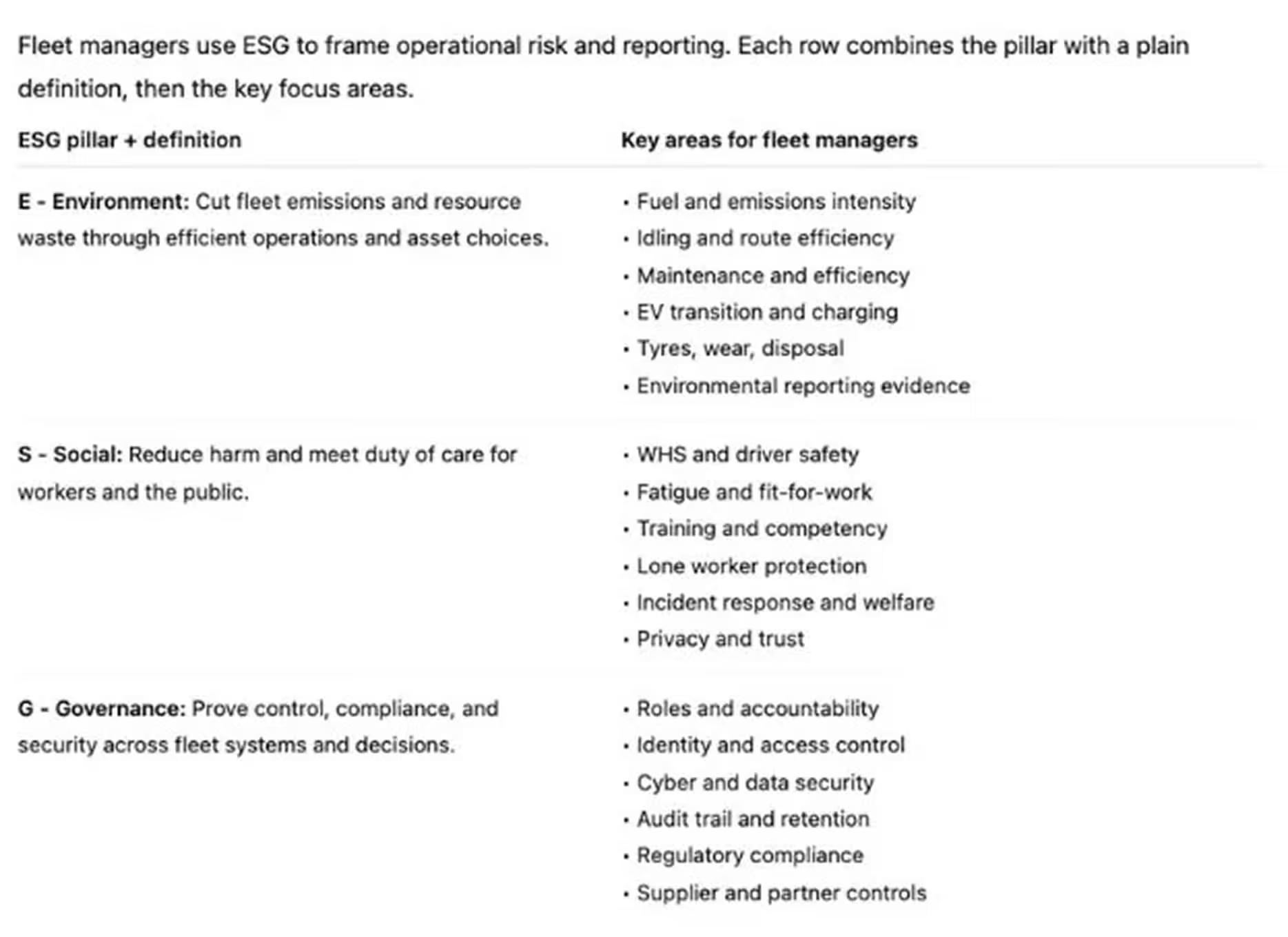
For businesses which run sizeable fleets, minimising their vehicles’ impact on the environment makes excellent sense and it’s an area where progress can be measured and built on in real time, not just reported annually.
Putting formal policies in place that mandate employees drive to conditions and avoid speeding can enable them to create a collective difference over the long term.
That’s because it’s been proven that smooth, safe driving results in lower fuel consumption, fewer incidents and accidents, and reduced wear and tear on vehicles.
Efforts to minimise risky and inefficient driving are more likely to be effective if aberrant behaviours are detected in real time and offending drivers prompted to correct them.
Carbon emissions can be cut by this and other straightforward measures, such as reducing vehicle idling time and facilitating carpooling for workers who need to travel to the same location at the same time.
Measuring what matters
Making changes such as these – and demonstrating you’ve done so – necessitates having access to up-to-date insights into how workers behave when they’re behind the wheel of company cars, utility vehicles and mobile machinery, as well as information on the condition and fuel consumption of those vehicles.
That’s where technology has a vital role to play. When fitted to vehicles, connected trackers and telemetric devices can sense their environments, deliver precise location awareness, capture granular data on how those vehicles are being driven, and create intelligent connections between devices, systems and people.
The signals devices detect and transmit can be sent to the corporate governance team who can use that intelligence to develop comprehensive ESG metrics for the company fleet.
The evidence generated can, for example, be used to build detailed pictures of driver behaviour; identifying individuals who regularly exceed the speed limit and those whose driving patterns are erratic or unsafe.
Interventions can be triggered once pre-determined thresholds have been reached and evidence of offending drivers’ subsequent behavioural changes measured and documented in Environmental and Governance reporting.
Fuel consumption and usage data can also be captured regularly and married with service and repair histories, for every vehicle in the fleet.
Using data to drive ESG improvements
Once in possession of these insights, an ESG team can develop a comprehensive set of fleet metrics and then instigate initiatives to improve them.
A compliance program for individuals who regularly drive unsafely can, for example, be an effective means of modifying their behaviour behind the wheel.
The detection of a risk event in real time means they can be given immediate feedback followed by coaching and counselling, to prevent a recurrence of the incident.
For example, should an employee contravene their employer’s ‘no mobile phone use while driving’ policy, their vehicle’s telemetrics system could detect the breach, prompt a correction, alert their manager, log the real time coaching that occurred and preserve the evidence for ESG reporting purposes.
In the long term, such positive actions can reduce fuel consumption and vehicle wear and tear while lowering the risk of incidents and injuries for the individuals involved and those with whom they share the road.
That’s a social outcome that’s in everyone’s interest, given the devastating impact of serious and fatal accidents on families and communities.
Meanwhile, having the capability to monitor lone worker settings and respond quickly to incidents involving danger and duress make for a significantly safer working environment.
Driving ESG improvements in 2026 and beyond
Monitoring and improving sustainability is a moral imperative for responsible Australian enterprises of all stripes and sizes and a legal one for many.
Fleet operations offer one of the clearest pathways from policy to measurable proof, at a time when reporting expectations demand greater transparency and defensibility.
The smart deployment of tracker and telemetric technology can help businesses reduce the environmental impact of their fleet vehicles, while creating safer conditions for employees and other drivers on the road.
It enables them to not only measure their vehicle emissions but to show the actions they’ve taken to minimise them, while at the same time safeguarding workers and the public.
If increasing transparency, managing risk and demonstrating solid environmental and social credentials is important to your business this year, it’s an excellent addition to the company toolkit.
Zetifi’s Smart Antenna platform combines high-performance UHF and 4G/5G antennas with Bluetooth tracking and GPS logging, offering seamless integration into existing telematics platforms.
It delivers the kind of infrastructure needed for real-time carbon accounting and verifiable sustainability metrics as ESG reporting shifts from voluntary to mandatory.

On the road and in the field — how technology can safeguard workers
This article was originally published on Safety Solutions and is republished here with permission.
Source: Safety Solutions – On the road and in the field — how technology can safeguard workers
___
For businesses with mobile and field workers, occupational health and safety obligations can be harder to meet. Zetifi founder and CEO DAN WINSON sets out how connected fleet safety can help.
While Australia’s stringent occupational health and safety frameworks have helped ensure our country’s workplaces are among the safest in the world; in recent decades, workplace fatalities remain a sad reality of life.
In 2024, 188 workers across the country lost their lives due to traumatic injuries incurred at work. Four in five fatalities occurred in just six industries: agriculture, forestry and fishing; public administration and safety; transport, postal and warehousing; manufacturing; health care and social assistance; and construction.
Machinery operators and drivers accounted for 32% of those fatalities, with vehicle incidents the leading cause of fatal injuries (42%), according to Safe Work Australia.
Ensuring the businesses they work for don’t add to these tragic statistics in 2026 should be an overarching goal for all occupational health and safety teams.
Tackling risk head on
How best to do so is the question, particularly for businesses and organisations which employ large teams of mobile and field workers.
For many of these organisations, identifying the gamut of potential risks their workers face when they’re out on the road is a sensible place to start.
And then there are the incidents and events over which employees have rather more control — think erratic braking, speeding events and unsafe overtaking.
Developing policies to mitigate these unavoidable and avoidable risks should be a priority for businesses that have not already done so. Mandating employees drive to conditions, avoid speeding and seek shelter during severe storms, for example, is a straightforward way of reducing the likelihood of them coming to grief on the road.
Obtaining insights from the field
But having policies in place that require workers to take sensible precautions is just one piece of the puzzle. Being able to enforce them is the other. To do so necessitates having access to up-to-date insights into how workers behave when they’re behind the wheel of company vehicles.
That’s where technology has a vital role to play. Devices today can sense worker environments, deliver precise location awareness and create intelligent connections between devices, systems and people through connectivity, telematics and applications such as duress and lone worker safety alarm tools.
The signals they detect and transmit can be swiftly and seamlessly interpreted and sent on to key personnel, who can use that intelligence to enhance worker safety on several fronts.
However, what’s required is reliable coverage anywhere, with alerts able to be transmitted kilometres away across the likes of a farm, mining site or national park. Smart antennas and seamless integrations with third-party applications such as telematics can help here and provide robust information on issues such as driver speed, braking, acceleration and cornering performance.
This type of connected fleet safety is ultimately about visibility and proof. By combining radio-based safety features with telematics, organisations can better understand risk, improve behaviour and demonstrate that safety controls are operating in practice.
Striving to improve worker safety
That’s reassuring for workers, particularly those who are regularly sent out on the road solo. For businesses, meanwhile, it demonstrates a willingness to walk the walk when it comes to occupational health and safety.
The data collected can also be used to build detailed pictures of driver behaviour; identifying individuals who regularly exceed the speed limit and those whose driving patterns are erratic or unsafe.
Training and coaching can then be employed to help these drivers modify their behaviour. In the long term, that can foster a more accountable, safety-oriented workplace culture, while reducing the risk of accidents and injury for the individuals involved and those with whom they share the road.
Creating a safer future for your team
An engaged, high performing workforce is the most powerful asset any business can have. Protecting the people whose contributions are pivotal to your organisation’s success is a moral imperative and one that makes excellent commercial sense too. Technology can help you do so, when they’re in the field and on the road.
If creating a safer workplace is a priority in 2026, it’s an investment that will pay dividends now and for many years to come.
Source: Safety Solutions – On the road and in the field — how technology can safeguard workers

Zetifi Wins Silver at the 2026 BETTER FUTURE Australian Design Award for Product Design Technology
Wagga Wagga, Australia, 6 February 2026 – Zetifi, an Australian wireless company that designs and manufactures smart antennas for cellular and radio devices with market-leading design, has won a Silver Award in the Product Design Technology category of the 2026 BETTER FUTURE Australian Design Awards.

Zetifi’s UHF CB Smart Antenna, designed and manufactured in Wagga Wagga, New South Wales, transforms the humble antenna into an intelligent connectivity hub enabling duress alerts, lone-worker check-ins, automated asset tracking, and real-time location reporting. Supported by multiple patents and a cross-functional team, the product sets a new benchmark for connected vehicle operations and safety, with practical benefits for drivers, fleets, and remote communities.
For decades, vehicle antennas for two-way radios have remained largely unchanged, simply passing signals to and from hardware hidden elsewhere in the vehicle. Zetifi’s UHF CB smart antenna is the first vehicle antenna with active electronics integrated into the housing. As a result, the point where RF enters the vehicle becomes the place where events are detected, processed and sent to the cloud. The design unifies GPS, Bluetooth, Wi-Fi, cellular and support for UHF radios in a single compact form, enabling safety and connectivity features from the antenna itself.
“Winning this award is recognition of our expertise and insight to imagine the possibilities, develop strategies to bring them into being and pursue market opportunities with precision and patience, says Dan Winson, Founder and CEO, Zetifi. “At the same time, our ongoing success is heavily contingent on the strength of Zetifi’s relationships with our key technology partners and dealer community which has enabled our company to achieve extraordinary growth and invest in solutions to meet market the demands of businesses requiring solutions for connectivity, worker safety and compliance reporting.”
Zetifi’s UHF CB Smart Antenna started with a clear goal: improve RF performance and deliver reliable coverage for vehicles in harsh, remote environments. Safety was always central. Better connectivity meant better chances for drivers and crews to get help when matters.
Achieving that needed more than a stronger antenna. It required coordinated work across mechanical design, RF, electronics, firmware, cloud architecture, app design and continuous field testing. Early prototypes focused on signal quality and resilience. Real-world use with farmers, contractors and road crews then revealed a larger opportunity.
Customers asked simple, practical questions. Could a UHF button press raise a duress alert? Could vehicles check workers in and out automatically? Could the system confirm that radios, PPE and tools were actually on board? All while the connectivity landscape was shifting fast, with Starlink and other networks suddenly making “coverage almost everywhere” realistic for vehicles.
That changed the brief. The antenna was no longer just a way to feed a radio. By integrating GNSS, Bluetooth, Wi-Fi and cellular into the housing, it became the natural place to sense location, detect nearby devices and send events to the cloud. The team iterated quickly, using on-road data and customer feedback to refine features.
The result is a smart antenna platform that replaces stacks of antennas, routers and telematics boxes. It uses Starlink and cellular for backhaul, and turns the humble UHF CB radio into a lone worker safety solution that can integrate, via open-source APIs, with enterprise platforms. At the same time, the antenna moves computing and control into the antenna itself. GNSS, Bluetooth, Wi-Fi, cellular and UHF sit in one compact housing with an open API into telematics and enterprise platforms, so the antenna mount becomes a location-aware edge device.
Key innovations included in the UHF CB Smart Antenna are:
- User-centred design: UHF button presses and BLE tag events trigger duress alerts, check-ins and location reports without extra screens or apps.
- Mechanical and assembly: Parallel radome profiles allow part reuse, while a compression holder for the PCB array adds strength and supports efficient assembly and heat paths.
- RF and electronics: RF simulation plus on-road validation, using on-board electronics to log performance over thousands of kilometres, enables refinement, RF quality assurance and the use of thin coax for cable management and longevity.
- Software and ecosystem: Open APIs, over-the-air updates and work with Icom and Telstra turn the hardware into a platform for safety and fleet features.
- Test and validation: Shaker table testing and long-term field trials underpin an industry-leading 5-year warranty.
In addition, the antenna itself is designed to use energy efficiently and to last. Careful RF and electronics design minimise wasted power and support long duty cycles in harsh conditions. Rugged construction, high ingress protection and vibration-tolerant mechanics reduce failures and the need for early replacement. At the same time, standard mounting and cabling, plus over-the-air firmware updates, extend the useful life of each antenna as software and use cases evolve.
About Zetifi
Zetifi is an Australian wireless company that designs and manufactures Smart Antennas for cellular and radio devices. Its technology is used across agriculture, fleet, mining and enterprise sectors and supports telematics, telemetry and safety systems for vehicles and field equipment.
Media Contacts
Zetifi
Leslie Beckman, Head of Marketing
0419 705 391
leslie.beckman@zetifi.com

Zetifi partners with Geotab to deliver Connected Fleet Safety in Australia
Wagga Wagga, Australia, 30 January 2026 – Zetifi, an Australian wireless company that designs and manufactures smart antennas for cellular and radio devices with market-leading design, quality, and performance, has announced a strategic partnership with Geotab, a global leader in connected vehicle solutions.
The partnership will deliver connected fleet safety insights to Australian businesses with a focus on providing clear, evidence-based visibility into driver behaviour, helping organisations understand how safely vehicles are being operated today and where risk exists.
Zetifi develops connectivity and safety technology for fleets operating beyond reliable coverage, with its Smart Antenna platform integrating telematics, two-way radio safety features, and enterprise workflows.
By combining Zetifi’s connectivity expertise with Geotab’s advanced telematics platform, businesses will gain access to practical driver safety insights including speed, braking, acceleration, and cornering performance. These insights support safe driving assessments and deliver risk management recommendations that help protect drivers, businesses, and directors through objective, defensible data.
Founded to solve connectivity challenges in regional and remote Australia, Zetifi embeds GNSS, onboard compute, and connectivity directly into its Smart Antennas. This enables reliable data capture at the edge and seamless integration with telematics, radios, and enterprise systems, turning everyday fleet activity into safety alerts, operational insights, and documented evidence for worker safety and governance.
“Connected fleet safety is about visibility and proof,” said Dan Winson, CEO of Zetifi. “Business owners and directors carry real responsibility for how vehicles are used at work. By combining radio-based safety features with one of the world’s leading telematics platforms, we’re helping organisations understand risk, improve behaviour, and demonstrate that safety controls are operating in practice.”
Geotab is a global leader in connected vehicle solutions, supporting fleets across government, transport, utilities, and commercial sectors in Australia and worldwide. Its open platform enables partners to extend telematics data beyond dashboards and into operational systems that improve safety, efficiency, and sustainability.
“Australian businesses face rising pressure to show active lone worker safety management,” said David Brown, Associate Vice President of Geotab, APAC. “We are pleased to welcome Zetifi to our network of partners. Zetifi brings two-way radio-based capabilities such as duress, lone worker check-ins and man-down into an organisation’s existing telematics system and workflows. That approach can add safety capability without the unnecessary complexity of layering in separate duress-specific platforms, while still supporting data-backed decisions to reduce incidents and protect people and business.”
The partnership is already live, with two Connected Fleet Safety pilots deployed in Australia and an entry-level offering available immediately. A broader national rollout will focus on industries with elevated vehicle and remote-worker risk, including agriculture, mining, utilities, construction, transport, and local government. Zetifi will deliver Connected Fleet Safety as a managed service, providing structured alerts, regular reporting, and board-ready evidence packs to support ongoing safety oversight.
About Zetifi
Zetifi is an Australian wireless company that designs and manufactures Smart Antennas for cellular and radio devices. Its technology supports telematics, telemetry, and safety systems for vehicles and field equipment across agriculture, fleet, mining, utilities, and enterprise sectors.
About Geotab
Geotab is a global leader in connected vehicles and asset management, serving approximately 100,000 customers worldwide. Headquartered in Oakville, Ontario and Atlanta, Georgia, Geotab leverages advanced data analytics and AI to optimise fleet performance, reduce costs, and drive efficiency. Processing 100 billion data points daily from over 5 million vehicle subscriptions, Geotab supports Fortune 500 companies, mid-sized fleets, and the largest public sector organisations, including the U.S. federal government. Celebrating 25 years of innovation, Geotab remains committed to safety, sustainability, and data security. Learn more at www.geotab.com.au
Media Contacts
Zetifi
Leslie Beckman, Head of Marketing
0419 705 391
leslie.beckman@zetifi.com
Geotab
Edelman for Geotab
Varsha Viswanath
Zetifi and Icom launch partnership to deliver a next generation UHF CB Radio solution for Australia
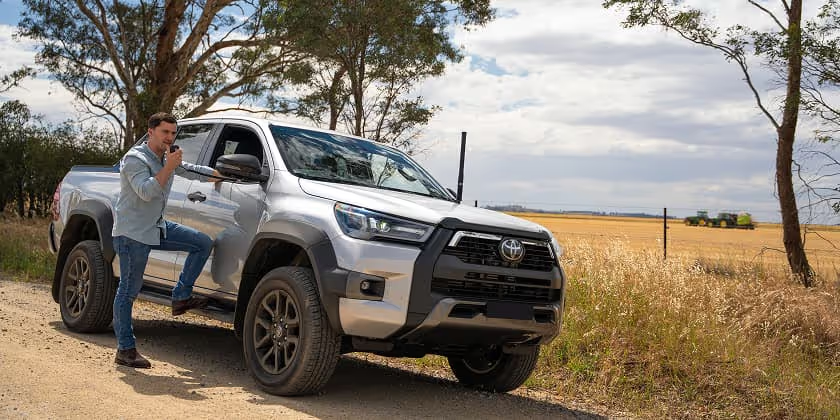
Zetifi and Icom have formed a partnership to introduce a new UHF CB Radio Pack that delivers a fresh wave of innovation to a market that has seen little technological change in recent years. The combined solution brings together Zetifi’s Australian-made Smart Antenna technology and Icom’s world renowned radio engineering to create a communications package designed for modern vehicles, demanding terrain and commercial field operations.
The partnership also sets the foundation for future developments in location services, duress alerts and advanced telematics that will be of particular interest to fleet operators, utilities, emergency services, mining, agriculture and 4x4 accessory dealers across Australia.
“Bringing Zetifi and Icom technology together marks an important step forward for UHF radio in this country. This partnership combines complementary strengths and sets us up to deliver safer, smarter and more connected solutions for Australian drivers and fleet operators. This launch is only the beginning of a broader roadmap that brings location intelligence, duress capability and advanced telemetrics into the hands of customers who rely on dependable communication every day.”
— Dan Winson, CEO, Zetifi
A new UHF CB Radio Pack for Australian conditions
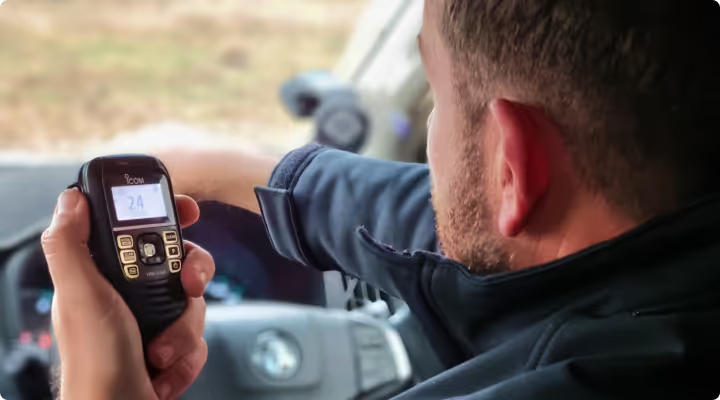
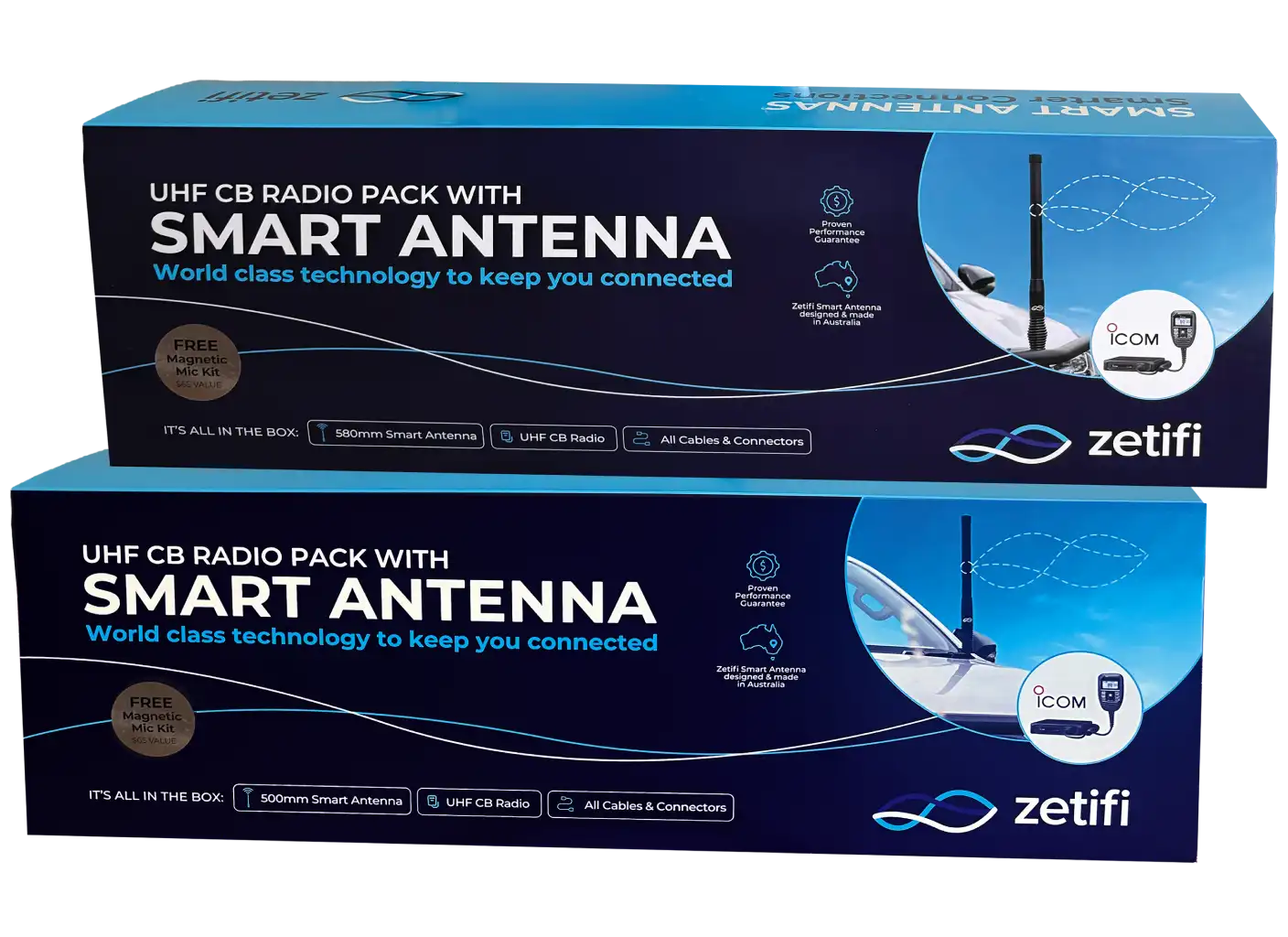
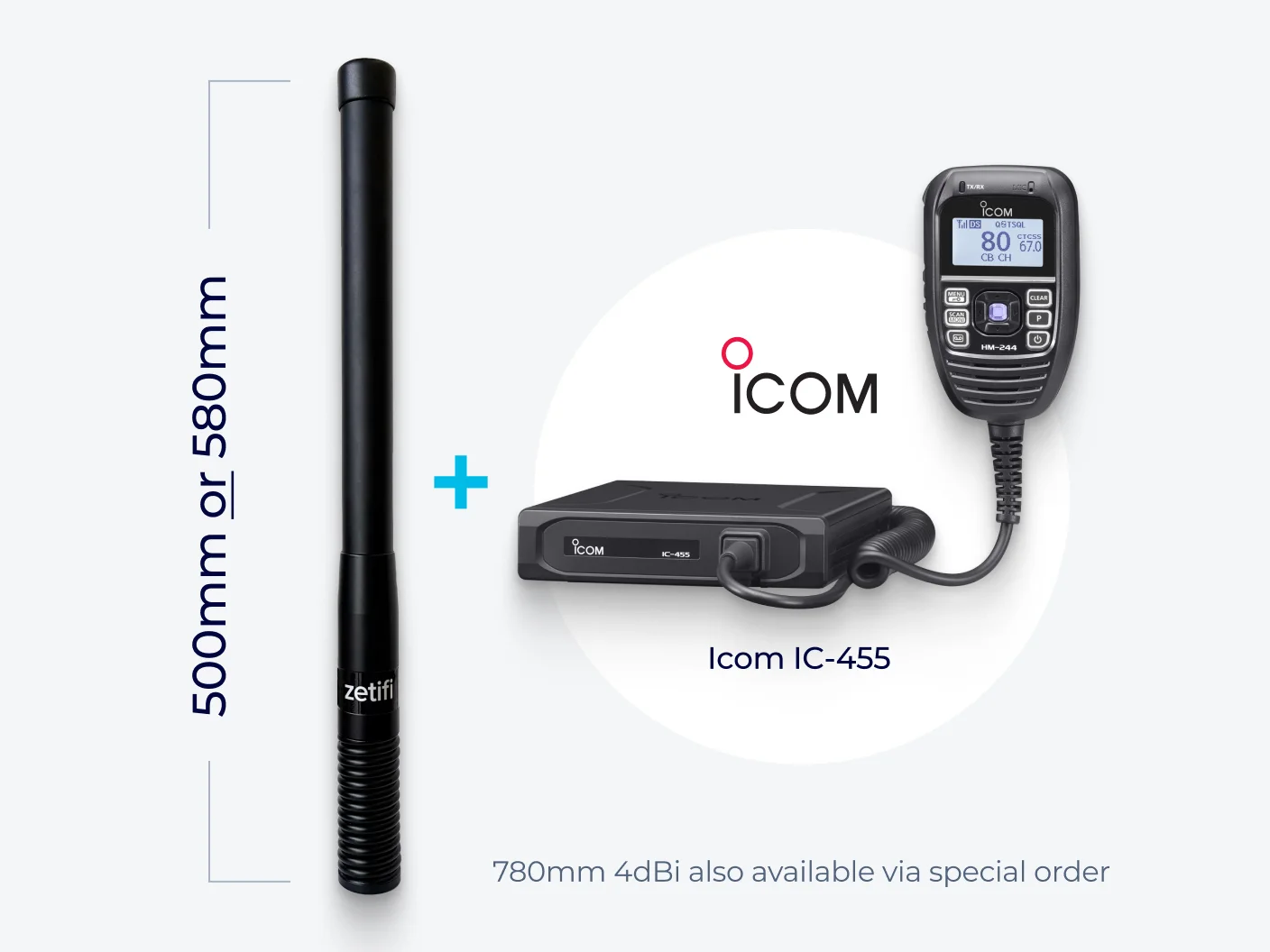
The pack pairs a core Zetifi Smart Antenna with the Icom IC-455 UHF CB radio to create a ready-to-install solution for 4x4 owners, trades, agriculture, transport and commercial fleets. It’s engineered for long service life, consistent clarity and dependable communications in the varied and often harsh conditions unique to rural Australia.
Zetifi Smart Antenna
Zetifi contributes its Smart Antenna platform, manufactured in Australia and backed by patented technology and a five-year warranty. Key features include:
- 3dBi gain for stable multi-terrain performance
- Heavy duty IP69K rated construction
- New matte black finish that reduces glare
- The only 500mm length CB antenna optimised for bonnets and a 580mm option for bull bars
- Proven performance guarantee.
The Smart Antenna platform also provides a pathway to optional onboard electronics that enable telematics, vehicle tracking and safety functions. These capabilities are currently in development with partners across agriculture, utilities, government and fleet management.
Zetifi technology is already used by a wide range of Australian organisations including Telstra, agricultural associations and rural connectivity programs. Local customers and installers such as Burdekin Communications in Queensland and field users across regional New South Wales have reported significant improvements in coverage and day-to-day reliability.
“Our focus is on practical innovation that improves safety and productivity in the field. The opportunity to integrate Zetifi’s antenna technology with Icom’s trusted radios allow us to move faster and deliver meaningful benefits to customers who depend on simple and reliable communication.”
— Dan Winson, CEO, Zetifi
Icom IC-455 UHF CB Radio
The pack includes the Japanese-made Icom IC-455, a 5-watt UHF CB radio known for clear audio, ease of use and long-term reliability. Features include:
- Loud and clear audio
- LCD speaker microphone with record and playback
- Automatic 12 V / 24 V voltage detection
- Five-year warranty
- Proven performance across Australian industry sectors
Icom’s UHF CB range delivers dependable communication solutions for emergency services, agriculture, mining, 4WD enthusiasts, and a wide variety of commercial and industrial applications. Built to military-grade standards, Icom’s UHF CB transceivers incorporate advanced communication technologies to ensure exceptional durability and performance. Models such as the IC-41PRO, IC-410PRO, and IC-455 are fully compatible with the 80-channel UHF CB network, delivering seamless connectivity and long-term reliability.
“Icom’s radio technology has been trusted globally across many sectors for decades. Our products are designed and built to last in the most challenging environments, tried and tested by military and humanitarian organisations. Working together with Zetifi strengthens our capabilities across the Australian market and further afield. Together, Zetifi and Icom will bring forward features that combine voice communications, location services and safety management into a single, flexible and modern platform.”
— Marty Anderson, General Manager, Icom Australia
Combined value for dealers and fleets
The new pack simplifies purchasing for Zetifi dealers and operators by providing a single, compatible, high-quality solution backed by aligned support and warranty programs from both companies. The combined strengths of Zetifi and Icom offer a clear upgrade path for future safety and telemetric features while retaining the simplicity of UHF CB communication that Australians rely on.
“MIB Projects works across the Pilbara where the environment demands equipment that is tough, dependable and easy to maintain. A solution backed by Zetifi and Icom gives us confidence that we can support our drivers and field teams wherever the job takes us.”
— Cameron Bunker, Managing Director, MIB Projects
Availability
The UHF CB Radio Pack will be available from 1 December 2025 through participating dealers nationwide and at Zetifi.com. Dealer enquiries are welcome through Zetifi.
About Zetifi
Zetifi is an Australian wireless company that designs and manufactures Smart Antennas for cellular and radio devices. Its technology is used across agriculture, fleet, mining and enterprise sectors and supports telematics, telemetry and safety systems for vehicles and field equipment.
About Icom
Icom is a global manufacturer of radio communications equipment with a long-standing history of serving both Australian consumers and professional users. Offering a comprehensive range of solutions—including Airband, Amateur, Land Mobile, UHF CB, Marine, LTE/Networking, and Satellite Communication — Icom products are built on a foundation of Japanese engineering and quality, earning worldwide trust for their performance, durability, and reliability.
Media Contacts
Zetifi
Leslie Beckman, Head of Marketing
0419 705 391
leslie.beckman@zetifi.com
Icom Australia
Kitty Mau, Marketing Manager
0409 017 979
kittym@icom.net.au
IP69K Certified: Confidence for Customers, Backed by a 5-Year Warranty
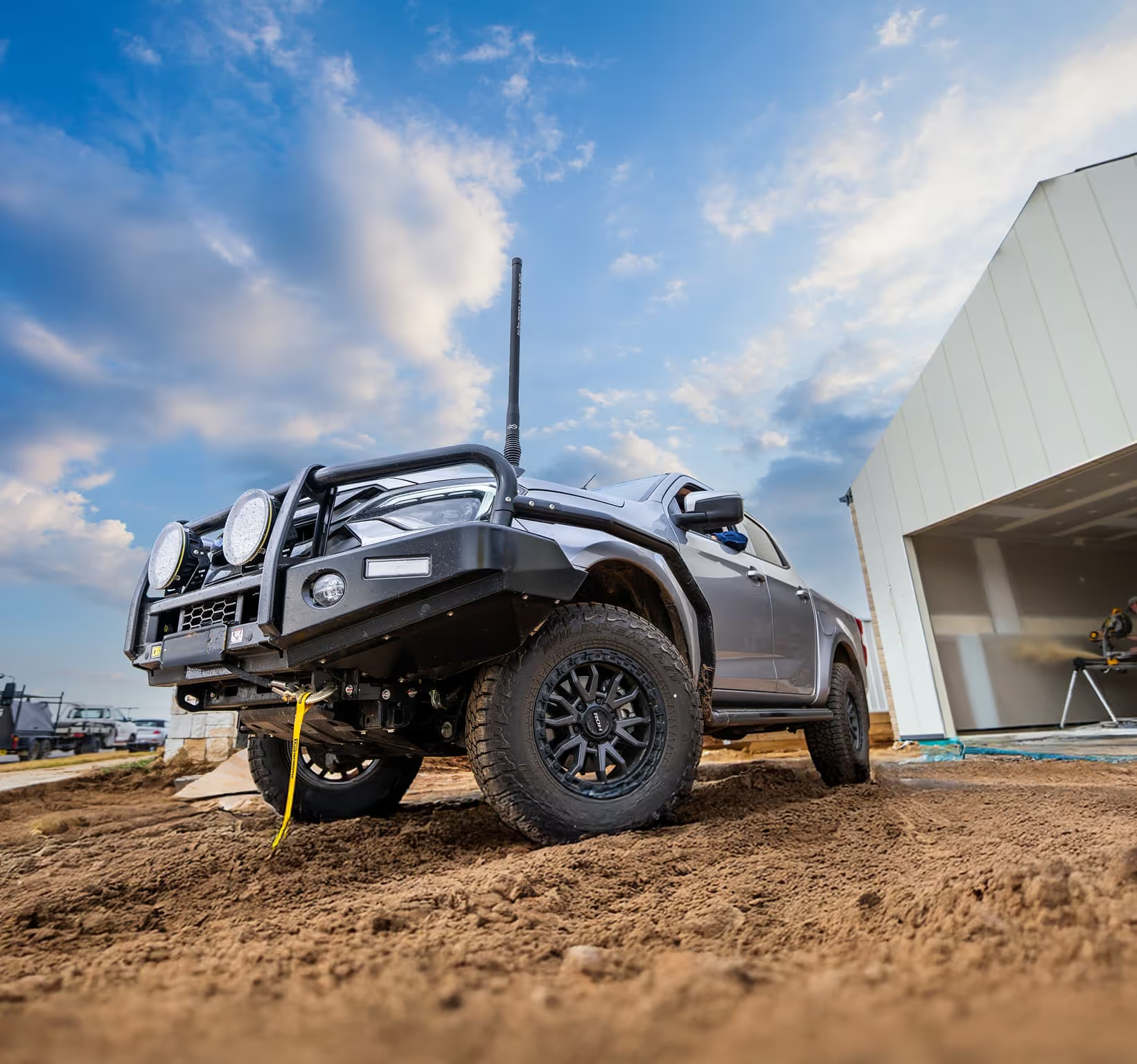
When you’re working in mining, agriculture, or any environment where equipment faces dust, mud, and regular high-pressure washdowns, you need technology that’s built to survive. That’s why Zetifi antennas are now certified to IP69K — the highest international standard for protection against dust and water ingress. This means our antennas can handle the toughest cleaning routines and the harshest conditions, giving you confidence that your connectivity will keep working, no matter what.
We back this up with a 5-year warranty, so you know your investment is protected for the long haul.
What is IP69K and Why Does It Matter?
IP69K is the gold standard for ingress protection. The “IP” rating system (Ingress Protection) uses two numbers: the first for solids like dust, the second for liquids like water. IP69K means the device is completely dust-tight and can withstand high-pressure, high-temperature water jets from every angle. For our customers, this translates to antennas that won’t fail after a mine site washdown, a muddy harvest, or a stormy day in the field.
What Does Certification Mean for You?
Our IP69K certification isn’t just a label — it’s independent proof from Compliance Engineering, a respected Australian test lab, that Zetifi antennas meet the highest standards. You can view the full test report and see photos of the testing process right here in this blog.
How Do We Achieve IP69K Protection?
Delivering this level of protection starts with great design and careful engineering. Every Zetifi antenna is built with precision-moulded housings and high-quality gaskets to keep out dust and water. The real secret is our use of potting compounds to fully seal the internal electronics. Potting fills every void inside the enclosure, creating a solid barrier that blocks dust, water, and steam — even under extreme pressure and temperature.
This approach means there are no paths for ingress, even during the most aggressive cleaning procedures. Our design team works closely with manufacturing to ensure every unit meets these standards, not just the ones sent for testing.
The Testing Process
Our antennas were tested by Compliance Engineering in Victoria, Australia, following international standards (AS 60529:2004 and ISO 20653:2013). The process included:
- Probe ingress tests to confirm no openings larger than 1 mm
- Dust chamber tests with talcum powder under vacuum
- High-pressure steam jet cleaning with 80°C water at up to 100 bar, from four angles, on a rotating turntable
After each test, the antenna was opened and inspected for any signs of dust or water ingress. The result: zero penetration, full compliance.
See the Results for Yourself
We believe in transparency. That’s why we’re sharing the full report and photos of the testing process. These show exactly how our antennas were challenged and how they performed.
Built for Your Environment — Guaranteed
IP69K certification gives you confidence that Zetifi antennas are ready for the harshest environments — whether it’s a mine site washdown, a muddy paddock, or a dusty outback road. Combined with our 5-year warranty, it’s another step in our commitment to delivering products that combine innovative design with uncompromising durability.
If you have questions about our testing, want to see the report, or need advice on antenna selection for your application, get in touch. We’re here to help.
.avif)
Engineering for Harsh Environments
We knew from the outset that better antenna performance would be a key differentiator. But we also understood that it had to be achieved in parallel with quality and durability that matched, or better yet exceeded, the best in the industry. That’s why antenna quality has never been an afterthought. It’s been a core part of our engineering culture from day one, guiding every decision from material selection to mechanical design and testing.
Antenna Quality Starts with Engineering Excellence
Best Materials - best in class quality starts with sourcing the best materials. We’re fortunate to have Warwick and Wei on our team. Their long careers at GME and RFI have given them deep insight into global supply chains and the standards required to build antennas that survive in the real world. While we compete with GME and RFI, we hold both companies in very high regard. They’ve set the benchmark for traditional antenna design and continue to build exceptional products. Zetifi is taking a different path, not by trying to outdo traditional manufacturers at their own game, but by innovating in both design and functionality.
Technology Innovation - while not all of our antennas contain active electronics, the methods we’ve developed to support those advanced features have raised the bar across our entire product range. Our work on smart antennas, including dual-gain models that dynamically switch between high and low gain, and combination LTE and UHF antennas that simplify installation and improve performance, has driven a deeper understanding of RF behavior, mechanical integration, and environmental resilience. These insights have allowed us to produce antennas with exceptional RF and mechanical performance, validated by millions of real-world data points from vehicles, farms, and field deployments across Australia.
Design Excellence - our mechatronics engineer Ben, also formerly of GME, led the development of our radome using a first-principles approach. We chose a parallel radome design, which is rare in the industry due to its added material cost. But it delivers two major benefits:
- Superior structural integrity, with better resistance to impacts like bird strikes and rough handling.
- Consistent internal geometry, allowing us to secure the antenna element using a custom injection-moulded component we call the PCB array support.
This support has a small amount of flex, just enough to tension the antenna element inside the radome. The radome itself is made from high-strength fiberglass with a manufacturing tolerance of ±0.1mm. The support compensates for this, eliminating rattle and ensuring long-term stability. Unlike foam, which compresses and degrades over time, our injection-moulded plastic maintains its shape and performance even after years of vibration and shock.
Vibration Testing: Simulating Real-World Abuse
To validate our designs, we use a Bruel & Kjaer V830-335 shaker table, a high-end electrodynamic vibration system used in aerospace and automotive testing. This machine allows us to simulate the full spectrum of vibration profiles encountered in real-world driving, including:
- Random vibration to replicate unpredictable terrain
- Sine sweeps to identify resonant frequencies
- Shock pulses to mimic potholes, bird strikes, and sudden jolts
The system delivers up to 9.81 kN of force, with accelerations exceeding 700 m/s², and supports payloads up to 160 kg. We run our antennas on this table for hundreds of hours at high intensity, simulating between 40,000 and 100,000 km of corrugated road driving. The vibration profiles are programmable, allowing us to replicate specific road conditions from different regions and vehicle types. Check out an example test:
After each test, we disassemble the antennas and inspect every component for fatigue, wear, and performance degradation. We’re not just looking to survive. We’re looking to outperform.
Real-World Validation and Warranty Confidence
Lab tests are only part of the story. We also offer an open invitation to anyone who has driven more than 200,000 km with one of our antennas: send it back, and we’ll replace it. Not because it has failed, but because we want to inspect well travelled antennas to ensure our lab simulations match field performance. We're glad to report that they do.
Antenna quality isn’t just a feature. It’s a foundation.
We’re confident in our materials, our design, and our testing, and we want our customers to be just as confident. That’s why we’ve increased our warranty from 2 years to 5 years.
Stay Connected on the Road: Why UHF Radios Still Matter for Caravans
Safer Overtaking with UHF: Why Every Towing Vehicle Needs One
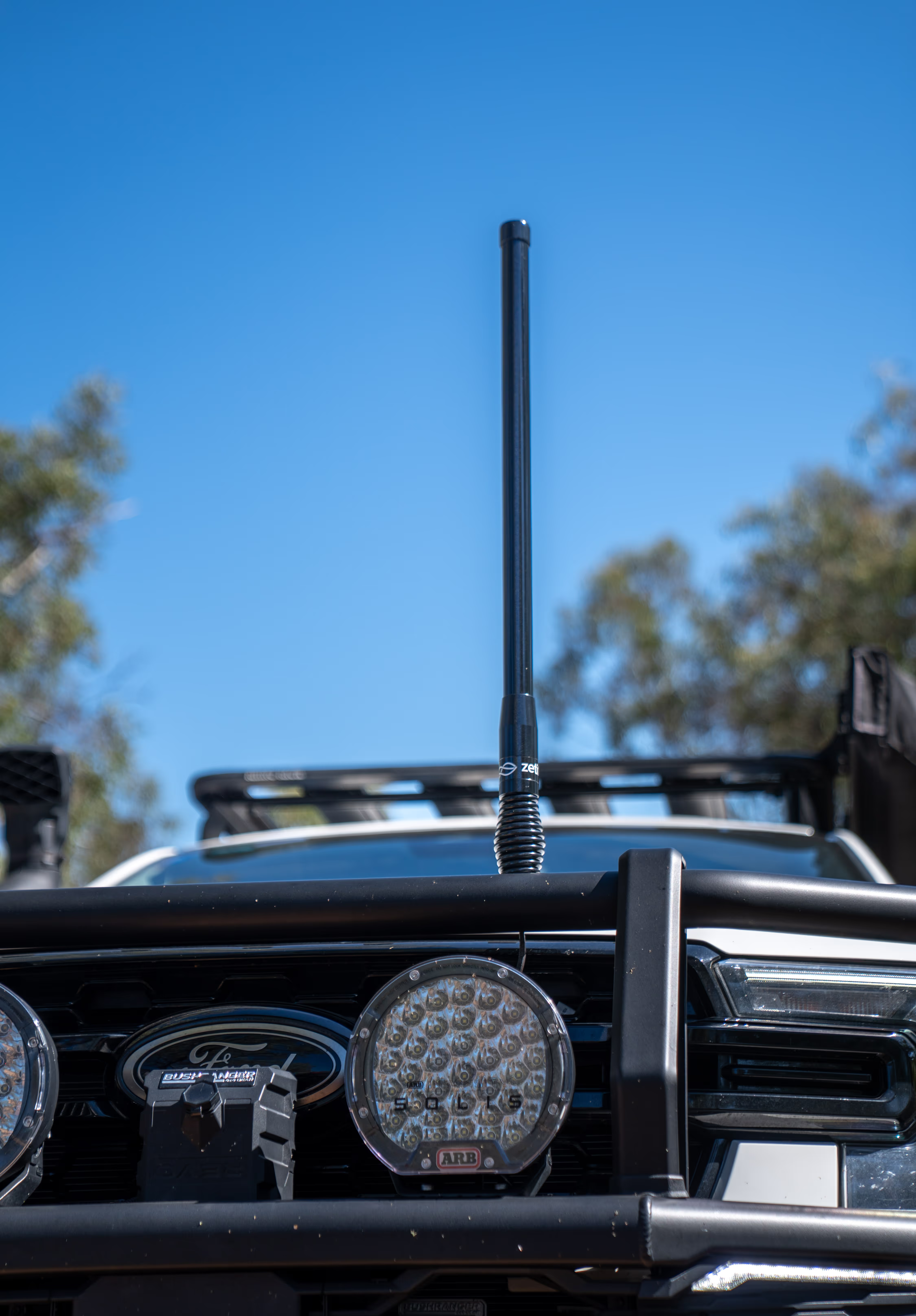
Truck driver Ben Stamatovich, known for his aerial photos as The Drone Way, recently shared a video that sums up why UHF is essential for caravan travel. While crossing the Nullarbor, Ben came up behind a caravan. The driver used UHF to let Ben know it was safe to pass. The result? A smooth, safe overtake - no guesswork, no close calls. As Ben put it, “All towing vehicles crossing the country should have a UHF. We just want everyone to get home safe.”
Most near misses between trucks and caravans happen because of poor communication. UHF is instant, simple, and the tool that both truckies and caravaners trust to make overtaking safe.
Why Zetifi UHF Antennas Make Overtaking Safer
- Built tough for Australian roads. Engineered to handle rough tracks, bad weather, and long trips.
- High performance. Delivers strong, clear UHF communication - so you always get the message across.
- Your way. Available as a dedicated UHF CB antenna or as a combo with cellular. Run a UHF radio and a mobile booster with just one antenna - less clutter, less hassle.
- Plug and play. Works with all popular radios and boosters.
If you’re towing, don’t leave it to chance. UHF radios save lives. Zetifi antennas make sure yours works better, lasts longer, and keeps you connected anywhere in Australia.
Watch the video below to see how easy overtaking can be when both drivers use UHF.

Zetifi Secures Landmark Industry Growth Grant to Take Smart Antennas Global
Regional Scaleup Zetifi Lands $5M Grant to Globalise Smart Antenna Platform
Wagga Wagga, NSW - 6 August 2025 - Australian technology company Zetifi has secured one of the largest grants to date under the Australian Government’s Industry Growth Program, supporting a $10 million initiative to commercialise its Smart Antenna platform globally.
At the core of the project is Zetifi’s patent-pending technology, which transforms antennas from passive components into intelligent edge devices. By integrating advanced RF engineering with embedded systems and cloud connectivity, Zetifi’s Smart Antennas enable seamless integration with third-party platforms - unlocking new capabilities such as real-time telemetry, remote diagnostics, enhanced mobile coverage using network data, and duress alerts for lone workers.
The project is being delivered in collaboration with global partners including Nextivity, Icom, and Telstra, who are working with Zetifi to explore and develop new applications for the Smart Antenna platform across public safety, enterprise connectivity, and regional mobility.
Nextivity (USA) – Technology Integration Partner.
Zetifi has partnered with Nextivity, the company behind the CEL-FI ROAM and CEL-FI GO cellular boosters, to enhance performance through deeper integration. By leveraging the Bluetooth interface in CEL-FI devices, Zetifi’s Smart Antennas can provide real-time location and network status information to the booster. This added information enables smarter band selection and improved system optimisation, making it possible for the booster to deliver signals to otherwise hard-to-reach places.
“Zetifi has reimagined the antenna. By combining the intelligence in the CEL-FI booster with Zetifi’s intelligent antenna design we can ensure coverage everywhere in Australia. The merged system works with both the terrestrial network as well as upcoming satellite services, utilising the latest technology to maximize effectiveness. We’re proud to collaborate with Zetifi to offer this transformative solution worldwide.” - Michiel Lotter, CEO, Nextivity
Icom Inc. – Enhanced Safety for Public and Enterprise Users.
In collaboration with Icom, a global leader in radio communications, Zetifi’s Smart Antennas will integrate deeply with mobile and fixed radio systems to deliver industry-leading Workplace Health and Safety (WHS) solutions. This integration includes GNSS-based location tracking, out-of-band duress alerts for lone workers, automated safety check-ins, and telemetry linked directly into enterprise management platforms such as Microsoft Power Platform.
“Our radios are trusted globally for their reliability in critical communications. Zetifi’s Smart Antennas present an exciting opportunity to build on that foundation - adding location intelligence, real-time duress alerts, and advanced telemetry that could further improve safety and connectivity for emergency services, utilities, and field teams. This flexible Icom + Zetifi solution has significant potential across our land mobile, UHF CB, and marine product lines." - Aaron Camp, Executive Officer, Icom Inc.
Telstra – Collaboration on Coverage Optimisation
Telstra and Zetifi are exploring opportunities to share network data to support improved mobile coverage and connectivity in remote and regional areas. This collaboration will enable Zetifi’s Smart Antennas to make more intelligent real-time connectivity decisions and deliver enhanced performance for field-based users. Telstra’s accelerator, muru-D, previously led Zetifi’s $12.25 million Series A funding round and continues to support Zetifi’s commercial expansion.
“Zetifi’s Smart Antenna platform represents the kind of innovative thinking needed to enhance connectivity for vehicles and field equipment. We’re pleased to be working withZetifi to explore how network data sharing can support smarter, safer, and more connected solutions.” - Shailin Sehgal, Global Head of Networks and Technology, Telstra
Zetifi - Intelligence at the Edge of Connectivity
Zetifi is an Australian technology company transforming antennas into intelligent edge platforms for vehicles, machinery, and infrastructure. By combining advanced RF engineering with embedded systems and cloud integration, Zetifi’s Smart Antennas enable enhanced connectivity, real-time telemetry, and seamless integration with enterprise systems - reducing complexity and unlocking new capabilities at the edge.
Dan Winson, Founder and CEO of Zetifi: “This is a defining moment for Zetifi. The support from the Industry Growth Program, alongside our strategic partnerships with Nextivity, Icom, and Telstra, positions our Smart Antenna platform at the forefront of global connectivity innovation. This technology does more than extend coverage - it delivers critical intelligence and enhanced capabilities in environments where it matters most.”
This project is supported by the Australian Government’s Industry Growth Program.
Connected Fleet Safety & Integration Showcase
Explore the convergence of radio comms, IoT, and IT in fleet safety.
If you manage fleets, build radio networks, or deliver digital systems, don’t miss this.
📍 Telstra Customer Experience Centre, Melbourne
📅 Wed 20 Aug | 11:30 am–1:30 pm | Lunch provided
See how Zetifi’s Smart Antennas connect UHF radios, Bluetooth tracking, and Microsoft Power Platform over Telstra’s NB-IoT.
Register now:
https://forms.enterprisenews.telstra.com/ConnectedFleet_Showcase

Engineer Spotlight: Wei’s Journey from China to Driving Innovation at Zetifi
At Zetifi, our people are the heart of everything we do. One stand out is Wei, a Smart Antenna engineer whose story is a powerful blend of technical expertise, resilience, and authenticity. Her path from China to Australia is shaped by a core belief: always stay true to yourself.
Wei began her engineering journey in China, enrolling in electronic engineering before being placed into a niche stream: microwave and electromagnetic engineering. It was a highly competitive field, and being one of the few women in her cohort made it even more demanding.
“Out of 120 students, only 20 were girls,” she says. “Later in the workforce, I was often the only woman engineer in the room.”
Despite the obstacles, Wei thrived. She started her career in the mobile phone technology sector and had a front-row seat to one of the most transformative periods in the industry, witnessing the decline of feature phones and the rise of smart phones.
“If you want to build great products, you have to take risks. Nothing is risk-free,” she explains.
Wei moved to Australia on a skilled visa and joined RFI, where she spent nearly ten years honing her skills and earning long service recognition. Along the way, she became a mother of two, balancing work and family with remarkable focus and determination.
She remembers one hectic day after returning from maternity leave. In a panic, she drove 40 minutes home to retrieve her breast pump, only to find it had been in her car the entire time.
“I was only sleeping four hours a night at that time. But I kept pushing and kept delivering,” she says.
Now at Zetifi, Wei brings that same energy and commitment to our antenna projects. She recently led the development of our Combo UHF and Cellular antenna, which required intense problem-solving just before the holiday break.
“It wasn’t just me. It was a team effort. No one complained. Everyone kept going until we fixed it.”
Wei’s mind set is practical and grounded. She focuses on the day ahead rather than stressing about long-term plans. Her approach is built on consistency, not perfection.
“I’m not a perfectionist. I’m productive. I finish what’s on my list today. That’s what makes a difference.”
Fridays are Wei’s personal recharge days. She reads, learns piano through a mobile app, and spends time with her puppy. These simple routines are part of how she stays grounded in both life and work.
When asked why she came to Australia, her answer is clear and unfiltered.
“I’d spent my whole life in China and wanted to see the world. I couldn’t afford the U.S., so I applied for skilled migration. When I got the visa, I came.”
Wei’s story is a reflection of steady progress, genuine passion, and the courage to be herself. We’re proud to have her on the Zetifi team and even prouder of the work she continues to lead.

TDRI workshop – consultation with emergency services leaders confirms need for novel connectivity solutions
Zetifi recently hosted a workshop to consult with emergency services experts and community stakeholders as part of our ‘Telecommunications Disaster Resilience Innovation’ (TDRI) project – a $1.65 million, two-year project funded by the Federal Government for Zetifi to develop and pilot innovative ZetiMesh technology in at-risk and disaster impacted communities. Our work on this project involves collaboration and support from Morse Micro, Telstra, and Risk-E Business Consultants, who played a key role in coordinating and facilitating this workshop.
This workshop was a great opportunity to foster collaboration and leverage the expertise of key stakeholders, including representatives from councils, emergency services, telecommunications carriers, and community groups, to advance telecommunications technologies for emergency situations.
Australia’s increasing vulnerability to extreme weather and catastrophic natural disasters such as the 2019/2020 bushfires, the 2022 SE QLD and Northern NSW flooding event highlight the critical need for reliable telecommunications and power supply. During these events, communities struggle in three key areas: communication for individuals in distress, local authorities delivering critical updates, and businesses’ ability to provide essential services and goods. Zetifi recognises and emphasises the importance of comprehensive telecommunication coverage for individuals, organisations, and society, especially during crises.

During the first half of the workshop, presenter George Holt from Zetifi guided discussions to gather critical insights into current telecommunications technology, including its usage, areas for improvement or innovation, user needs, frequency of use, access points, and maintenance and funding considerations. Participants and stakeholders critically examined telecommunications issues in natural disaster situations based on their expertise and personal experiences. Insights were discussed at the current operational level and with prospects for pre-, during, and post-crisis scenarios, including evacuation centres, frontline workers, and their modes of power, communication, and transport vehicles.
George Holt’s reflection on his involvement in the project: “It’s been a huge responsibility… We have a unique opportunity because we are working with combat and service agencies that are desperately keen to support communities. I wanted to get these people on board and start a conversation. The most important thing was to establish that relationship.”
Subject matter expert Dave Owens provided invaluable insights during the TDRI workshop. With over 30 years of experience as a commissioner in the NSW Police Force and as a State Emergency Controller, Dave specialises in emergency management, including evacuation, recovery, and animal safe places. He co-chaired the NSW independent inquiry into the 2019/2020 bushfires and authored the ‘Welfare Services Functional Area Sub Plan’ for evacuation centres. As the founder and CEO of Risk-E, Dave’s involvement in the TDRI project is crucial for connecting with emergency service stakeholders and providing critical expertise.

The prospect of developing telecommunication technology to address communication challenges during natural disasters is an aspirational project for Zetifi and the TDRI stakeholders.
The knowledge gained from this workshop is informing the development of our plans for the project and our designs for innovative solutions that build on the work Zetifi has already completed in launching products that connect farms, fleets and 4x4s.
Stay tuned for more updates. Our first technology pilots of the ZetiMesh solution with project partners including Murrin Bridge LALC, Wagga Wagga City Council, NSW RFS and NSW Police, are planned for early 2025.

3G Shutdown Considerations: Checking Antenna & Signal Repeater Compatibility
With the closure of the 3G networks, Australians need to make sure that their signal repeaters and external antennas are configured and suitable for 4G and 5G. This guide explains what you need to know to ensure your Cellular Antenna and Signal Repeater remain compatible and highlights the role of innovative solutions like the Zetifi 4G/5G Smart Antenna in maintaining continued connectivity well into the future.
Antenna Compatibility
If your coverage has got worse since the 3G shutdown, don’t automatically assume it’s because there is less coverage now that 3G has been turned off. It might be because your external antenna isn’t optimised for the frequency bands required to connect to 4G and 5G connectivity. Older antennas that were purchased at a time that 3G was the main network in rural areas may not be compatible with these newer networks.
To verify that your cellular antenna supports 4G and 5G frequencies, you can check the data sheet for your antenna if you have one or use the CEL-FI WAVE app to verify your antenna’s compatibility with the 4G network:
- Access the Advanced Tab: In the CEL-FI WAVE app, go to the ADVANCED tab.
- Under SUPER CHANNELS tap on Radio A Band <number>: 4G boosting. Note: the band number shown might be 3, 28, 1 or 7 depending on your device and the frequencies available from your local tower
- Perform a Signal Strength Test. Check the Donor RSRP level. A value between -40 and -110 dBm indicates good signal strength.
- Perform a Signal Quality Test. Look at the Donor SINR. A value of 0 dB or a negative number may indicate issues.

Mobile Repeater Compatibility
All Nextivity CEL-FI and Telstra GO repeaters that have been sold in Australia support both 3G and 4G networks. While these devices are not impacted by the 3G shutdown, they might be configured to operate only on 3G frequencies. To ensure continued 4G coverage:
- Download the Cel-Fi WAVE App: Available on the Google Play Store or Apple App Store, this app allows you to manage and configure your GO Repeater settings.
- Check Your Repeater Settings:
- Open the app and connect to your repeater via Bluetooth.
- Go to Settings > Band Settings and ensure that 4G is selected under Technology.
The Zetifi 4G/5G Smart Antennas: Future proofed solution amid transition to 4G and 5G
Zetifi’s Cellular 4G/5G Smart Antennas offers a future-proof solution for maintaining connectivity. Designed specifically for 4G and 5G networks, it covers the range of frequencies necessary for reliable rural connectivity ahead of the 3G shutdown and beyond. It is particularly beneficial for those traveling in rural areas where maintaining a stable connection can be challenging.
For more information or assistance regarding the compatibility of your antenna and signal repeater, visit Nextivity for technical support. For questions about the Zetifi Smart Antenna, contact our team at 1300 093 711 or visit our Smart Antenna page.

Zetifi plus Powertec Wireless Technology – a match made in phone boosting heaven!
Zetifi has signed a national distribution agreement with Powertec Wireless Technology as our exclusive master distributor to the telecommunications, IT, and marine radio markets around Australia. With Powertec being one of the world’s largest sellers of Nextivity’s CEL-FI signal repeater devices, it’s a logical collaboration that will help more Australians access vital coverage boosting solutions.
It’s widely accepted that traditional cellular network providers can’t provide ubiquitous phone coverage in a country as big as Australia. This is one reason why Gold Coast-based Powertec have had such success with Nextivity’s CEL-FI phone signal repeater devices, with up to 300,000 Australians in rural and remote Australians relying on these devices to improve phone service in their vehicle with these devices.
However, phone boosters are only as good as the external antenna that they’re connected to, so the arrival of Zetifi’s revolutionary Smart Antennas is an obvious fit for Powertec according to their Distribution Manager, Brenton Roy.
“Zetifi’s new smart antenna technology represents a major advancement in rural and remote connectivity. We’re proud to partner with Zetifi to bring this innovative solution to market, helping Australians stay connected with reliable, adaptable, and high-performance communication tools. This partnership underscores our commitment to delivering top-tier wireless solutions that address the unique challenges faced by our customers.
“The combination of Zetifi’s innovative antenna technology with the Nextivity R41 product is a powerful synergy. This partnership is about integrating cutting-edge technology with market-leading products to ensure our customers have access to the best connectivity solutions available.”
As a regionally-based innovator and manufacturer, collaborating with an established distribution partner like Powertec will rapidly accelerate the reach and adoption of our smart antennas, according to Zetifi Chief Operating Officer, Warwick Clancy.
“We’re thrilled to be partnering with Powertec, a company that shares our commitment to innovation and customer service. Our Smart Antennas are designed to tackle the unique connectivity challenges of regional and remote Australia, and with Powertec’s extensive distribution network and expertise, we’re confident that we can reach more people and make a real difference in their lives.”
This shared vision emphasises the commitment both companies have to improving connectivity for all Australians.
The collaboration will also focus on expanding the reach of the Nextivity R41, a product proven effective in various challenging conditions. Clancy added:
“The opportunity to work with Powertec on expanding the reach of the Nextivity R41 is particularly exciting. This product has proven itself in a range of challenging environments, and together, we can ensure that even more Australians benefit from enhanced mobile coverage, no matter where they are.”
Zetifi’s partnership with Powertec represents a significant leap forward in addressing connectivity challenges faced by Australians in regional and remote areas. With a shared commitment to innovation and excellence, this partnership is set to make a meaningful difference in the lives of many. As Zetifi and Powertec work together to roll out these advanced solutions, we can expect a new era of reliable communication across the Australian landscape. Stay tuned for updates on this exciting new partnership!

Scaling up: Zetifi’s path to mass-market products
It’s been six years and quite the journey for Zetifi since an enterprising network engineer from Wagga Wagga had an idea he thought could improve connectivity for farmers. The idea involved filling coverage gaps with Wi-Fi and has since blossomed into a flourishing technology company that will soon be launching their first mass-market products.
Zetifi’s first office was the backroom of a local computer store. Founder Dan Winson was allowed to use the unoccupied space to start piecing together the Wi-Fi solutions he thought could help farmers with their connectivity and it wasn’t long before the first prototypes started rolling out the door.
Fast forward six years and many iterations of those initial product ideas later, and the business has grown to a team of 30 that counts Telstra and GrainCorp as their main investors via a $12 million Series A capital raise. This investment was always intended to provide Zetifi with the resources required to take their products from small-scale innovative solutions through to mass-market products that are ready to meet the growing demand for their solutions in Australia and beyond. Zetifi has doubled the size of its product development and engineering teams in the last year in what has been a truly transformative period for the business.
“It’s been a phenomenal ride,” says Chief Product Officer and the company’s second employee, Paul Maybon. “Like any start-up, the early days involved taking on any job that needed doing and just hoping that we knew enough to get some wins with customers willing to take a punt and let us test our ideas. The farmers we worked with were incredibly supportive, I think because they were just so happy to meet people who were trying to help with them with their connectivity.”
The core idea behind Zetifi’s Wi-Fi coverage extension products is this; with the advent of smart phones that can use Wi-Fi to make phone calls just as easily as they can use a cellular signal, it is now possible to provide a service for phone calls and data by extending any internet connection as long-range Wi-Fi.
This resulted in two main products in this product family; a ZetiCell that provides permanent Wi-Fi around sheds or homesteads, and the ZetiRover, which provides roaming Wi-Fi for vehicles and farm machinery in the paddock or on the open road.
“Early on, people saw the benefit of having a single solution you can use to make phone calls and to connect cameras or other Wi-Fi enabled devices,” Paul says. “In those days we were using a lot of 3D printed components to create what we needed at low cost. But it was slow going – sometimes we had six or seven printers running day and night.”
Nonetheless, the hands-on approach had big benefits. It enabled the team to transform their ideas into new technology that scales Wi-Fi solutions as consumer connectivity products. The $12m capital injection from Telstra, GrainCorp and other investors gave the team additional capacity and funding required to re-engineer their flagship ZetiRover product as the first ready for mass-market adoption.
“Before the capital-raise we were just keeping up with orders, whereas this year we were able to hire senior engineers who know how to scale a product like the ZetiRover and still manufacture it locally, which is very important to us,” Paul says. “We are excited about the many improvements coming with the new ZetiRover and being able to promote it widely without the concern of any late nights 3D printing components just to keep up with orders!”
Zetifi’s next generation ZetiRover will begin field trials in early 2024.
This story is based on an article that first appeared in the Telstra Regional Australia e-newsletter in November 2023.
Pictured: Paul Maybon, Chief Product Officer, with the new ZetiRover.

Zetifi and Telstra Labs unite under one roof to accelerate tech innovation
In a strategic move to foster innovation and address common industry needs, Zetifi and Telstra Labs / muru-D have announced a teaming agreement. This collaboration aims to leverage the strengths of both entities in areas such as agriculture and emerging technologies, including AI, IoT, Wi-Fi, and 5G, to unlock new product and market opportunities.
As a testament to the depth of this partnership, Zetifi will be relocating five of its staff to Telstra Labs, Melbourne, starting November 2023. This relocation signifies a commitment to deepening the relationship between the two organisations and accelerating product incubation efforts.
Deon Liebenberg, Strategic Partnerships & Innovation at Telstra Labs, expressed his enthusiasm for the collaboration: “We are thrilled to welcome Zetifi into the Telstra Labs family. This partnership embodies our shared vision for the future of technology and communication. By bringing our teams together, we are poised to drive unparalleled innovation and address the pressing needs of the industry. The future is bright, and we look forward to the groundbreaking solutions that will emerge from this collaboration.”
Echoing the sentiment, Ben Letchford, Chief Technology Officer at Zetifi, shared his excitement: “Uniting with Telstra Labs is a significant milestone for Zetifi. We believe that by working cohesively under one roof, we can amplify our efforts in adjacent technologies and expand our reach to new customer segments. This collaboration is not just about shared space; it’s about shared vision, ambition, and the drive to make a meaningful impact in the tech landscape.”
The agreement between Zetifi and Telstra Labs / muru-D is a testament to the shared vision of both organisations. It underscores their commitment to pushing the boundaries of what’s possible and delivering cutting-edge solutions that address real-world challenges.
Pictured (left to right): Kelvin Ye, Alex Ottenhoff, Deon Liebenberg (Telstra), Connor Smith, Todd Essery (Telstra), Ben Letchford, David Nguyen, Dave Bell (Telstra).
About Telstra Labs / muru-D – Telstra Labs is Telstra’s innovation and research arm, dedicated to envisioning and creating the future of technology and communication. With a focus on emerging technologies such as 5G, IoT, AI, and more, Telstra Labs is at the forefront of driving innovation in the tech industry. For more information, visit Telstra Labs’ website.

Kickstarting regional STEM careers
The STEM disciplines of science, technology, engineering and mathematics are a huge part of everyday life at Zetifi. On any given day, you can be sure that members of our team are progressing research, solving problems, or challenging the status quo in electronics, networking, RF engineering, software, firmware, mechatronics and production engineering. Nothing energises us more than a STEM challenge. STEM is essential to the development of our products and a core part of our company’s identity and culture.
For many of our team members, their STEM interests and projects don’t finish at the end of the work day. Their engineering side projects often become captivating or hilarious topics during lunch discussions and slack conversations. From the electrification of motorbikes, automated home sprinkler systems, astrophotography, and even a secret fleet of autonomous micro-submarines – our team is certainly an eclectic and interesting bunch! Many of the skills and passions they cultivate at home directly contribute to our product and technology development.
A recent addition to our engineering team, Amy Combs, is no exception. Amy joined us a couple of months ago as a Junior Product Designer and has already proven herself to be a great contributor, despite being in just her first year out of school. This comes as no surprise considering her already impressive list of STEM achievements. Amy was the Dux of her school, created a functional prototype of a triathlon wet suit with an integrated ECG heart monitor as her Design & Technology major work, and won the 2022 SUBs in Schools competition for the design and manufacture of remotely operated micro-submarine she developed as part of her school’s SUBs in Schools team. This team victory was part of her school’s involvement in the fantastic F1 in Schools run by Re-Engineering Australia. Amy is continuing her association with this competition by mentoring teams from her old school and recently served as a judge for the 2023 NSW state finals of the F1 category, in which teams design, manufacture, and race a miniature CO2-powered F1 car.
During her time at Zetifi, Amy has been working closely with another of our young stars, Callum Maybon, and has made important contributions to the commissioning and testing of new printed circuit boards (PCBs) that will power our next generation ZetiRover and ZetiCell products. Next year Amy will combine her work at Zetifi with engineering studies at the University of Southern Queensland.
We also have other recent school leavers, such as Edward Trevaskis and Connor Summerhayes, working with us as part of our production team to help us meet the growing demand for our products. If you’ve purchased a Zetifi product in 2023, it’s likely that Edward or Connor had a hand in assembling and testing it.
As a regionally based business, we take great pride in providing opportunities for talented young people like Amy, Callum, Edward, and Connor to launch their careers in manufacturing and STEM in a regional city. They work alongside vastly experienced engineers and product developers, some of whom have over 40 years’ experience in their field!
We’re always on the lookout for new talent that shares our passion for STEM and solving rural connectivity challenges. If you or someone you know would be a great fit for our team of enthusiastic engineers and developers, please don’t hesitate to get in touch with us at careers@zetifi.com.
Pictured (left to right): John Lucas (obscured), Amy Combs, Callum Maybon, Paul Maybon.

Revolutionising connectivity: from farms to fire trucks
Pioneering wireless technology company Zetifi has been awarded a $1 million grant from the NSW Bushfire Commercialisation Fund, in a testament to the company’s commitment to adapt its novel wireless technology — initially designed for farms — to the critical communications sector. This development marks a significant step forward in enhancing connectivity for emergency services.
Zetifi’s journey began with a vision to bridge the digital divide in rural areas, particularly on farms, where reliable internet connectivity was a longstanding challenge. Company founder Dan Winson, a network engineer from Wagga Wagga, experienced firsthand the frustrations of limited connectivity in rural and remote areas and this experience inspired him to establish Zetifi in 2017, with a focus on developing cutting-edge wireless solutions for farms.
Zetifi’s initial breakthrough was the creation of ‘sleepy’ solar-powered wireless repeaters, which extend the reach of existing Wi-Fi networks across vast agricultural landscapes. This allowed farmers to monitor their equipment, manage irrigation systems and gather crucial data remotely. With the support of more than $8 million in government funding to develop and commercialise the technology and a recently completed $12 million capital raise led by Telstra and GrainCorp, Zetifi’s product line-up has expanded to include long-range Wi-Fi hotspots, vehicle and machinery gateways, and location-aware smart antennas.
It became clear that Zetifi’s potential extended beyond the fields, with the company’s technology having proven resilient and adaptable — qualities essential for critical communications, especially during emergencies like bushfires. The Bushfire Commercialisation Fund recognised this potential, leading to the recent grant award that aims to adapt Zetifi’s technology for the needs of the critical communications sector.
The implications of Zetifi’s adaptation for first responders are immense. Firefighters often operate in remote areas with limited connectivity, making effective communication a challenge during crucial moments. With Zetifi’s technology, fire trucks can now be equipped with long-range Wi-Fi hotspots, enabling real-time communication, data exchange and information sharing even in the most remote locations from a small number of vehicles equipped with satellite connections out to the masses of vehicles and firefighters. This interconnectedness enhances coordination, situational awareness and resource allocation during firefighting operations, ultimately leading to more effective and safer outcomes.
The Bushfire Commercialisation Fund’s recognition of Zetifi’s potential underscores the importance of collaboration between the private and public sectors in addressing critical societal needs. As Zetifi’s technology finds new applications in emergency response, it stands alongside a range of existing and emerging technologies that hold promise for safer and more efficient firefighting operations.
This article first appeared in the September/October 2023 issue of Critical Comms.

Former GME CEO Warwick Clancy joins Zetifi as Chief Operating Officer
Zetifi is very pleased to announce the appointment of ex-GME CEO Warwick Clancy to the role of Chief Operating Officer as part of a new-look leadership team.
Warwick began his career in Wagga Wagga before commencing a 24-year stint at globally recognised radio communications developer and manufacturer GME, including 5 years as General Manager Operations, and 7 years as CEO & Managing Director between 2013 and 2020. He brings extensive experience in the design, manufacture, development and distribution of electronics and radio communications products.
As COO, Warwick will be responsible for driving operational excellence, scaling manufacturing, and key commercial negotiations with distribution and channel partners for the ZetiRover and ZetiCell product lines.
He will work closely with CEO Dan Winson to execute on the mass-market growth strategy outlined as part of the company’s recent Series A capital raise.
“I began my career with an electronics trade in Wagga Wagga many years ago, so it seems fitting that I now have the chance to contribute the experience I’ve accumulated since to help Zetifi realise the potential of the technology they’ve developed,” said Warwick.
“I’ve been impressed by the talented team they’ve assembled, their innovative technology, and strong vision for solving rural connectivity, and I look forward to contributing to their continued success.”
Zetifi CEO Dan Winson points to Warwick’s industry connections and understanding of potential manufacturing and commercial partners for similar electronics products as being an ideal fit for the business.
“We’ve proven ourselves to be very capable of developing unique solutions through our iterative design process, prototyping, and batch manufacturing for these products, but we’re now at a stage where we need to scale these ideas and products to capture a broader market,” said Dan.
“It’s a critical commercial juncture so we’re absolutely delighted that Warwick has agreed to join us and apply his experience and leadership to guide us through this scale-up phase as we know it will have its share of challenges.”
Warwick’s appointment has also enabled some other important changes to the Zetifi leadership team as they commence 2023. The Zetifi leadership team is now as follows:
- Dan Winson, Chief Executive Officer (2017 – present) – Dan founded Zetifi in 2017 and has served as CEO since that time. He will continue in this role.
- Warwick Clancy, Chief Operating Officer (2023 – present) – Warwick began at Zetifi on February 1st, 2023.
- Paul Maybon, Chief Product Officer (2023 – present) – Zetifi’s longest-standing employee after Dan, Paul transition from the COO role which he has held for the previous three years to lead product engineering as Chief Product Officer.
- Ben Letchford, Chief Technology Officer (2021 – present) – Ben will continue as CTO. He recently returned to the company’s Wagga Wagga head office after spending the last 12 months in Rochester, NY, USA, where he established a satellite technology office for the business.
.avif)
It takes a village to raise a startup
By Dan Winson, Zetifi CEO & Founder
We rarely stop for long enough to reflect on our progress and achievements at Zetifi.
I’m making an effort to change that and with the announcement of our Series A last week, it seems like a good time to thank a lot of people and share some thoughts on our plans from here (tldr: we need even more amazing people, DM me if you’d like to talk).
Has it really only been four years?!
It seems impossible that it was only four or so years ago that it was just me experimenting and building product prototypes at the back of Think Technology’s office in Wagga.
Back then, I was generally on the tools, learning what works and what doesn’t on dusty cattle stations in the Northern Territory and other farms all around the country. A combination of good fortune, hard work and generous support from farmers, friends, family, investors, and the state and federal governments has allowed us to build a talented team that has now grown to 20 staff in Wagga, Sydney, Melbourne, and New York!
Over the past 18 months, we’ve deployed hundreds of pilot systems and refined our offers for vehicle, machinery and farm connectivity into products that are ready for the transition to mass manufacturing and a mass market launch.
Last week we announced our $12.25m Series A round led by Telstra and GrainCorp with participation from existing investors including Cultiv8 Funds Management, GrainInnovate, and Artesian. The support we’ve had from investors is a testament to the quality of our team and technology but it’s also recognition that there is a genuine need for our solutions and that the market for providing coverage extension in rural and remote areas is going to continue to grow as farmers and other rural businesses look to adopt connectivity dependent tools and technologies.

We’re very grateful to be in this position so it’s nice to have this opportunity to thank all those who’ve had a hand in preparing us for the next stage of this incredible journey.
- Firstly, we need to thank the hundreds of Aussie farmers who continue to work with us in developing, trialling and refining our technology. You have provided us with the inspiration to tackle this challenge and the education on what farmers need when it comes to connectivity. In particular, the innovators like Andrew Sevil and Wally Newman who led the way by solving their own problems – thanks for letting us come along for the ride.
- For taking a chance on a big idea and embracing the challenges and sacrifices that come with early-stage startup life I need to personally thank our families, which for me requires a special thank you to my amazing wife @Melissa Winson, not only for tolerating my constant focus on Zetifi but for being the best partner anyone could ask for – without your insights, intelligence and resilience there is no way we could be making this happen.
- For providing your time, knowledge, contacts and in many cases, capital, we’d like to thank our board, advisors and investors, especially Scott Newham, Hakan Eriksson, Richard Skellern, David Skellern, Luke Harwood, Rob Williams, Guy Hudson, Jonathon Quigley, Malcolm Nutt, Jordan Jeffery
- Finally, the various Government and industry stakeholders that have helped us take our technology from concept to reality. Your support has enabled the R&D activities and the commercial pilots needed to learn many valuable lessons. Without you, we wouldn’t be ready to build products that can solve rural connectivity problems at scale. DPIR NT, Wagga Wagga Council, NSW Chief Scientist, DPI NSW, Investment NSW, CSIRO, Food Agility, NSW Telco Authority, DPIRD WA, MADFIG, LIFT, Department of Communications, DAWE, AusIndustry, AMGC, EvokeAg, Grow-NY, Cornell University, Birchip Cropping Group, Case IH, SpaceX, Delta Ag, Essential Energy, Motorola Solutions, University of Technology Sydney, Charles Sturt University, Elders, Nutrien, Intersales, Total Ag, Hutcheon & Pearce, TELUS & Telstra.
What a team!
Last but definitely not least is a very big thank you to the incredible team we’ve managed to pull together over the last few years. Being able to start a technology company in regional Australia presents some challenges so being able to continually find or attract top-quality people to join us with specialised skills in networking, software engineering, systems design, manufacturing and more at just the right time has been amazing.
We’ve taken on some big projects that have challenged us but every single time our team has stepped up to achieve and exceed expectations.
The feeling of hitting a project deadline or deploying a big order with every member of our team knowing they’ve played a critical role in making it happen is a pretty special feeling that you can’t get without a lot of hard work. You have to be a ‘doer’ to make it at Zetifi! We’ll celebrate that appropriately at this year’s Christmas party.

Our plans from here – come and join us!
Our top priority right now is using these funds will be used to grow our teams in Wagga Wagga, NSW and Rochester, NY, USA while establishing new offices in Sydney and Melbourne. We’ve already commenced recruitment for software engineers, data scientists and other technical staff and will be advertising for sales and customer success roles soon. We’re unashamedly using the media attention from our raise, including this post, to attract the best candidates possible – if you know someone we should be talking to please send them to zetifi.com/careers or ask them to reach out directly via careers@zetifi.com.
We’re excited to be getting to work on scaling the delivery of the solutions we’ve developed. We know that this is just the next step. No doubt there are plenty of challenges and hard work ahead of us still but we’re incredibly pleased to be given the chance to do it with the resources we need to succeed.
Let’s go!!
Dan

“More reliable communication day in, day out” for Anthony Shepherd
Independent sheep production consultant, Anthony Shepherd, operates his Sheep Matters business from his Cootamundra farm. He travels more than 50,000 kilometres every year visiting clients and he’s been using the 5G ZetiRover as part of his day-to-day activities travelling across NSW, southern QLD as well as eastern and southern parts of South Australia. In all his travels there was only one spot in south-west Queensland where he couldn’t get coverage with the ZetiRover and he experienced “more reliable communication day in, day out”.
For Anthony, where his vehicle is the office, this has allowed him to work far more efficiency and service his clients more effectively as he can make phone calls, attend Zoom meetings, and access his client’s data in real-time, such as livestock weights, pedigrees, etc.
As a part of Anthony’s service, he helps clients get set up with the TruTest Walk Over Weighing (WOW) system on-farm. The WOW system enables daily weight information to be gathered on individual livestock to help monitor animal health and meet production targets. In the initial setup phase Anthony often needs to be able to talk to the technical support personnel based in Sydney and they sometimes need to gain remote access in. The use of the ZetiRover has greatly improved this overall process so it can be completed there and then in the paddock.
NOTE: This case study was researched and written by Birchip Cropping Group as part of the Australian Government-funded 5G Innovation Initiative (5GII) project. The 5G enhanced mobile broadband ZetiRover unit was provided to Anthony Shepherd free of charge for the period of the trial.

Hutcheon & Pearce trials roaming Wi-Fi to help TECSight precision ag team to work more efficiently
“Connectivity is key” for Agronomy and Precision Agriculture (PA) service providers where much of their work requires problem-solving in the paddock and having access to a suite of information sources. Many agronomists have begun to rely on cloud-based farm management platforms to record and communicate their recommendations to clients. The increased sophistication of modern farm machinery since the advent of GPS guidance and variable rate application of farming inputs has also increased the importance of reliable connectivity for machinery suppliers so they can help farmers get the most out of the equipment they provide.
For this reason, the team from Hutcheon & Pearce, one of Australia’s largest dealers of John Deere machinery, was keen to trial the 5G ZetiRover units to help their service and precision agriculture specialists to work more effectively and efficiently as they travel through the country.
For James Niemeyer and John Dailey, PA specialists from Hutcheon & Pearce’s TECSight division that helps farmers get the most out of the modern John Deere machinery supplied by the business, the 5G eMBB ZetiRover made a “measurable difference” to the service they could provide. James spends a lot of time out in the field supporting clients with their machinery and ag tech solutions. Before having a ZetiRover installed on his ute, James would have to drive up the nearest hill to make a call and/or to access My John Deere (the online data and support portal for John Deere machinery) and in some cases where the coverage was that bad James would have to make notes in the paddock and then return to the office to make the necessary calls, view data, seek advice on parts etc. which was not the most efficient use of time.
Whilst only being able to trial the ZetiRover for a short period of time James Niemeyer has been able to increase the timeliness of information being relayed to clients which has allowed for more timely operations and time savings just by simply being able to get jobs done out in the paddock. And with more and more information becoming available on the web including the ability to access machinery manuals online, James believes “talking to the cloud will be paramount” and service providers in the agronomy and precision ag space will need to be connected.
John Dailey had a similarly positive experience with the 5G eMBB device, commenting that his “life revolves around the internet” due to the range of programs he now uses to help clients achieve the best outcomes on-farm in his role with TECSight. For example, John uses T3RRA Cutta, an in-cab landforming system that combines with elevation data to help users to design, optimise and implement earth moving operations, resulting in minimal earth being moved to achieve the same water movement outcomes for irrigation farmers. With the ZetiRover, John was able to download and upload data right there in the paddock rather than waiting until he returned to the office. This not only saved him time but also delivered the information back to the farmer instantly.
Another way John has found the ZetiRover useful was the connection range from his vehicle, with Wi-Fi still usable as far as two hundred metres from his vehicle. This came in handy when downloading and uploading shape files that determine variable rate prescriptions into client’s machinery. In the past John relied on a SIM card in his laptop which was very hit and miss, or would hotspot off his phone – often requiring him to jump in and out of the tractor cab multiple times to get the files transferred. With the ZetiRover however John was able to remain in the tractor cab to download the file and he found it to be “5-6 times quicker” with the ZetiRover in comparison to hotspotting off his phone.
Tom Hensgen, After-Market Sales Manager at Hutcheon & Pearce also trialled a ZetiRover and for him being able to connect to online meetings whilst on the road has been a big boost to his productivity and meant that he has not had to dedicate specific ‘office days’ to attend, instead fitting them in amongst other activities.
Photos (top to bottom): 5G ZetiRover unit on Hutcheon & Pearce service vehicle; Zetifi staff Spencer and Ramon installing 5G ZetiRover on Hutcheon & Pearce vehicle.
NOTE: This case study was researched and written by Birchip Cropping Group as part of the Australian Government-funded 5G Innovation Initiative (5GII) project. The 5G enhanced mobile broadband ZetiRover units were provided to Hutcheon & Pearce free of charge for the period of the trial.

Making the most of Bayer FieldView with ZetiRover connectivity
For Nina Guo, Product Manager of Digital Farming ANZ at Bayer, “the ability to improve data connectivity” in regional Australia is an exciting prospect and something that has the potential to help users of Bayer’s FieldView platform, which was only recently launched in Australia. FieldView is a digital platform that uses a piece of hardware called the ‘FieldView Drive’ to read data from the machine and deliver real-time data to the user in the cab. The technology has the potential to boost yields through insights and options for metre-by-metre tailoring of seed rates, spraying, weed management and more.
Being able to make these data-driven decisions in real-time requires reliable connectivity. For this reason, Nina and the Bayer team were very keen to trial the 5G ZetiRover with some of their FieldView customers as “they would be solving quite a big issue” and eliminating a potential barrier to adoption for this innovative new technology.

The 5G ZetiRover enhanced mobile broadband (eMBB) device was installed on the tractor of Rhys Thomason to provide connectivity to his Bayer FieldView system. Most of Rhys’ time evaluating the 5G ZetiRover connectivity was while he was working with the FieldView system on a broadacre cropping operation to the west of Darlington Point in the Riverina region of NSW. Phone signal is usually very poor in this area but he found that the ZetiRover provided reliable connectivity for his phone and the FieldView system worked well in all locations. Interestingly, the data collected by Zetifi showed that the ZetiRover connected to 5G Telstra coverage at a distance of 11 kilometres from the township; much further than would be possible with a phone handset alone.
Photos: 5G ZetiRover unit mounted on Rhys Thomason’s tractor while he works the fields to the west of Darlington Point, NSW.
NOTE: This case study was researched and written by Birchip Cropping Group as part of the Australian Government-funded 5G Innovation Initiative (5GII) project. The 5G enhanced mobile broadband ZetiRover unit was provided to Rhys Thomason of Commins Enterprise free of charge for the period of the trial.

Roaming Wi-Fi means AgWorld everywhere for Burkinshaw Farming
The Burkinshaw family operate a mixed farming operation to the west of Wagga Wagga. As part of the 5G Innovation Initiative (5GII) project that Zetifi delivered with Australian Government funding they were provided a 5G-enabled ZetiRover unit to evaluate whether it could address the patchy coverage on their property.
Craig Burkinshaw and his son William were very pleased with the results. The ZetiRover helped with timeliness of data entries, access to agronomist recommendations in real-time via the AgWorld platform, and making phone calls while out and about in the paddock.

In contrast to some of the other triallists that participated in the 5GII project, the Burkinshaw’s also moved their rover around onto different machinery and vehicles depending on the key activities on farm. During sowing William had it set up on the cabin of their Case IH tractor so he could be entering data into AgWorld whist spraying and sowing. AgWorld is an online farm management software package that allows users to capture any information they want to about what is happening in each paddock as well as help keep farmers and their advisors connected with any changes made to plans updated in real time. Prior to using a ZetiRover there would often be delays in receiving recommendations from their advisor. Syncing data entries also had to wait until Will travelled through an area with better service or back at home on the computer. With the ZetiRover, however, there were no such delays. At other times of the year when more hours are spent elsewhere the ZetiRover was moved to his dad’s ute so he could keep business ticking over by being able to make and take calls whilst travelling around the farm.
Photos: 5G ZetiRover unit mounted on the Burkinshaw’s Case IH tractor on their farm west of Wagga Wagga, NSW.
NOTE: This case study was researched and written by Birchip Cropping Group as part of the Australian Government-funded 5G Innovation Initiative (5GII) project. The 5G enhanced mobile broadband ZetiRover unit was provided to Burkinshaw Farming free of charge for the period of the trial.

Improved connectivity increases running time for SwarmFarm Robotics autonomous machinery
Self-driving tractors and other autonomous farm machinery promise many transformative benefits for the future of farming. They have the potential to reduce labour costs, improve farming precision, and can allow farmers to use their time more productively on other tasks to optimise their operations. Various prototypes and some autonomous machines are currently available to Australian farmers; however, connectivity remains a big barrier to their adoption.
One such company that specialises in autonomous machinery is Australian agtech company SwarmFarm Robotics. SwarmFarm are true pioneers and they have the runs on board to prove it, having recently revealed that their autonomous robots have already covered one million acres of farm land through over 55,000 hours – an impressive achievement that puts them ahead of many much larger companies that are now trying to catch up in the race to full autonomy. Despite this success, poor connectivity continues to be a major barrier to adoption as it hampers much of the functionality of the robots and can seriously impact on running time if an operator loses contact with the SwarmBot. For this reason, SwarmFarm were very keen to assess Zetifi’s connectivity solutions to alleviate this pain point for their customers.

Field Service Coordinator for SwarmFarm, Dustin Van Nek, recently trialled a ZetiRover on SwarmBot robot that was guiding a 12m wide Weed-It autonomous sprayer on a farmer’s property in the Darling Downs, QLD. Two SwarmBot sprayers were in use on the farm so Dustin was able to compare the Zetifi product mounted on one, to their standard 4G solution that was running on the other. In terms of improving serviceability of the machines Dustin noted that when software engineers were required to login and do remote updates, pull data down from the cloud and push it into the machines (a twostep process) “the SwarmBot with the ZetiRover had completed both stages before the traditional 4G solution had completed three quarters of the first stage”.
The superior coverage from the ZetiRover also improved the upload speed for coverage maps, meaning that the farm owner could see a more accurate coverage map showing where the SwarmBot had been working. The farmer commented that when checking the two SwarmBot coverage maps the one with the ZetiRover had a complete coverage map loaded and the robot connected using SwarmFarm’s legacy 4G connectivity solution was a significant way behind.

Another important function that benefited from improved connectivity was the ability of the robot to send photo and video footage to the phone app for review by the operator when it encounters an unexpected obstruction. Being able to send these photos to the operator in real-time so an instruction can be given as to whether the robot should continue with the assigned task is critical in maximising the running time of the SwarmBots.
In addition, Dustin also had a ZetiRover mounted to his work ute and found that “being a field service coordinator I’m constantly in contact with field service fitters and support staff. It [the ZetiRover] has certainly increased the coverage so that I can remain productive because I spend a lot of time in my vehicle which is essentially unproductive hours for me.”
Photos (top to bottom): SwarmBot fitted with 5G ZetiRover and Weed-It Sprayer boom at FarmFest 2022; Close-up of 5G ZetiRover and antenna array on e-box of SwarmBot at FarmFest 2022.
NOTE: This case study was researched and written by Birchip Cropping Group as part of the Australian Government-funded 5G Innovation Initiative (5GII) project. The 5G enhanced mobile broadband ZetiRover units were provided to SwarmFarm Robotics free of charge for the period of the trial.

Improved connectivity enables Elders Stud Stock to boost on-farm cattle sales
As a stock and station agent for Elders Stud Stock, an important component of Jenni O’Sullivan’s role is ensuring the success of premium sheep and cattle auctions across north-eastern Victoria and southern NSW.
Reflecting a digital trend that is helping to improve the accessibility of livestock sales, Elders often makes use of the AuctionsPlus online auction service to stream video and audio of livestock auctions. Online auctions can significantly increase the competitiveness of the sale and have enabled Elders to host successful auctions during peak COVID periods when auction attendance numbers were impacted by border closures and other social restrictions.
Unfortunately, mobile blackspots are common on host properties, and this limits the extent to which Jenni can use online auction platforms at her customers’ properties. According to Jenni, online auctions are a win-win situation for everyone but only when she has sufficient coverage.
Jenni purchased a ZetiRover from Zetifi in August 2020 so she could offer the benefits of online live auctions to more of her clients. The ZetiRover is a portable Wi-Fi solution that provides the best possible coverage with high-gain antennas and multi-carrier technology which provides access to the Telstra and Optus networks. If there’s even a faint signal available, the ZetiRover will find it! It’s also built to withstand the dirt, dust and rain that come with life on the farm.
With the ZetiRover, Jenni can now confidently stream high-quality video and audio from stud sales and other on-farm auctions, regardless of where she is. She can also use the ZetiRover on her vehicle when travelling between auctions and meetings to reliably make and receive phone calls via Wi-Fi Calling.
“Elders has firm auction start times and with the ZetiRover I’m now able to interface with AuctionsPlus and use my phone when I need it most,” said Jenni. “If you haven’t got the confidence that you can make a call or easily get information, our whole day would just fall over. Having that uninterrupted connectivity makes a big difference to helping serve our customers and the productivity of the business.”

Warakirri Cropping connects to the NBN with Zetifi
One important difference between Zetifi and traditional carriers or internet service providers is the ability to use the full range of backhaul connections available when designing farm Wi-Fi solutions.
The availability of the nbn network right across Australia makes it an ideal backhaul choice for many farmers. By combining the nbn connection with Zetifi’s ruggedised long-range Wi-Fi products, farmers can extend the nbn to their sheds, yards and machinery.
One such project has dramatically improved connectivity at Bullarto Downs, a large broadacre cropping farm owned by Warakirri Cropping Group in Hopetoun, Western Victoria. The project has enabled Farm Manager David Drum and his staff to access the nbn Fixed Wireless network for the first time and has transformed voice and data blackspots into connected spaces.
A solar-powered microcell repeater from Zetifi at a neighbouring property captures the fixed wireless connection and sends this to a base station at the farm.
“The connection we had before was very marginal because of the distance from town but with the new nbn-Zetifi system we’re able to run Zoom meetings and use Wi-Fi Calling to help our phone calls. It’s been good this year because with COVID we’ve had a lot more meetings via Zoom,” said David.
“We use it for a lot of things. I have regular Teams meetings with my manager and all the data for our monthly reports is in the cloud, so we need to be able to access that. There’s nothing worse than working on those reports and the systems aren’t talking to each other properly.“
As well as these uses of connectivity in the office, it’s the increasing use of software to manage the day-to-day running of the business that is really changing things.
“It’s not until you really think about it that you realise how much we use the internet. We run software that manages our cropping program and spray treatments, online safety software, and our tractors run the MyJohnDeere platform which means I can login and see the same screens as the bloke out in the paddock, and you need good internet to do that,” said David
“Computers are getting faster and becoming more important and sometimes out here you may not have that connectivity on your phone, but with the NBN we’ve got good high-speed data coming through. Knowing that we’ve got a reliable connection through the Fixed Wireless network and the nbn-Zetifi setup has made a big difference.”
From this initial success, the site is now one of many farms across Australia at which Zetifi utilises the powerful backhaul capacity of the nbn™ network to provide true last-mile connectivity to sheds, yards, machinery and paddocks.
As Zetifi CEO Dan Winson explains, these projects extend the benefits of the nbn™ network beyond the farmhouse and offer new possibilities that will improve productivity for agricultural businesses of all sizes.
“When you talk to farmers, you quickly realise that they’re some of the most innovative people you’ll meet so they’re naturally very switched on to technology and what it can offer them,” Mr Winson said.
“These days a lot of that technology requires connectivity so extending Fixed Wireless beyond the farmhouse or office and into the paddock has enormous potential for IoT devices and other agtech solutions.
“There is a rapidly growing market for connected devices that track the movement and weight of livestock with electronic identification and precision agriculture with smart tractors becoming the norm.
“The backhaul capacity of the nbn is absolutely vital for us to deliver these solutions in many locations around Australia.”
FOOTNOTE
This story first appeared on page 12 of ‘Connecting Australian Agriculture’ – an important joint report from nbn and the National Farmers Federation that was published on 9 November 2021. The report is the starting point for a three-year partnership between these two organisations that aims to lift the digital capability of Australian farmers as a key factor that will help Australian agriculture grow to a $100 billion industry by 2030. It showcases many other on-farm applications of the nbn network to improve productivity in agriculture.

Zetifi announced as connectivity provider for Australia’s first fully-automated farm
In May this year, Charles Sturt University and Food Agility announced that they will partner to build the Global Digital Farm, Australia’s first fully-automated commercial farm, at Charles Sturt’s AgriPark in Wagga Wagga.
The Global Digital Farm will demonstrate the future of farming through pioneering projects involving robotics and artificial intelligence and by creating new sustainability and carbon models to drive improvements in farming practice.
Connectivity is essential for many of these technologies and for this reason it is fitting that the first of these projects to be announced involves Zetifi providing long-range Wi-Fi connectivity that can be accessed right across the farm.
Zetifi will work alongside researchers at Charles Sturt University and University of Technology Sydney to develop antenna arrays that can be fitted to mobile and stationary farming equipment to provide long-range communication. Tractors and trucks will become roving Wi-Fi devices with a range of up to 5 kilometres to provide farm-wide internet coverage.
Food Agility Chief Scientist, Professor David Lamb, said the new technology would be enabling infrastructure for Australian agriculture.
“Improving connectivity for Australian farmers is the single most critical factor in driving productivity and sustainability in agriculture,” Professor Lamb said.
“Farmers increasingly rely on high-level data analytics, automation and networks of devices that talk to each other over vast distances. This new technology will connect people and devices far beyond the farm gate and will be the backbone for the future of autonomous farming.”
CEO of Zetifi, Dan Winson, said farmers deserved the same connectivity for their businesses as those in urban areas.
“I’ve seen farmers perform the most amazing acts of contortion, hanging out tractor windows and climbing up ladders, trying to get a decent connection,” Mr Winson said.
“This will be an Australian-designed solution, made for Australian conditions to deliver connectivity wherever it’s needed on the farm. It will complement NBN wireless broadband and satellite coverage, helping farmers to transfer critical data across our vast landscapes.”
The technology will be a combination of adapted off-the-shelf and bespoke solutions, including a custom antenna array that is being developed in collaboration with experts from the University of Technology Sydney.
Co-Director, RF and Communication Technologies Laboratory (RFCT) at UTS and Sensing Innovations Lead at Food Agility CRC, Dr Negin Shariati explains the technology in development.
“At the heart of communication system which provides long-range connectivity is an antenna. RFCT-UTS researchers will design new types of antennas integrated with custom RF module for enabling long-range communications in smart farms, ” Dr Negin Shariata said.

$396k Advanced Manufacturing Growth Centre grant to commercialise the ZetiGate
Zetifi has been awarded $396,000 via the Federal Government’s Advanced Manufacturing Growth Centre to commercialise the ZetiGate – an innovative wireless network gateway that uses software-defined networking to seamlessly combine the speed of low-earth orbit satellite technology with the reliability of a backup 3G/4G LTE network.
Low-earth orbit satellites are 60 times closer to earth than traditional satellites and by reducing the distance that data has to travel and serving a smaller number of users, the technology offers the promise of higher speeds, more data and lower latency than traditional satellite connections.
The project will focus this emerging technology on the needs of the Australian food and beverage sector as poor connectivity currently limits the application of digital technology during key stages of the supply chain for regional food and beverage producers. The benefits of improved connectivity and digitisation include greater transparency for food provenance and traceability via real-time monitoring and the use IoT monitoring data to guide critical manufacturing or processing decisions.
By addressing the reliability and coverage issues of existing technologies, the ZetiGate delivers the fast and reliable connectivity that food and beverage manufacturers need to fully embrace digitisation throughout the supply chain.
You can read more about the project at https://www.amgc.org.au/project/zetigate-connecting-the-food-beverage-supply-chain/

Zetifi joins Australian AgriTech Association
Zetifi is excited to have joined the recently established Australian AgriTech Association which aims to foster new connections amongst farmers, investors and innovators and cement Australia’s position as a world-class agritech ecosystem.
Technology partnerships with farmers and companies such as Case IH and AuctionsPlus have already played an important role in Zetifi’s development and as CEO & Founder Dan Winson explains, providing a connectivity platform that enables farmers to embrace digital agritech applications is central to the company’s identity and mission.
“Zetifi was founded on the realisation that farmers were poorly served by traditional telecommunications technologies – plenty of people were developing digital solutions for farmers but not nearly as many trying to solve the connectivity issues that were preventing them from adopting this technology in the first place,” said Dan
“We’re based in regional Australia so having easy access to farmers has meant we’ve been able to speak with them directly and develop solutions that are specifically suited to this environment.
Whilst some of the innovations have required developing custom software to make installation and support possible in remote locations, some of the most important lessons have been the most basic, as Product Development Manager John Lucas explains.
“What farmers actually want is pretty simple – connectivity that’s resilient, is available where they’re working, and won’t give up on them because of some dust or mud. That’s what we set about building, and we’re now confident that our suite of products can meet these needs in most environments.”
Zetifi is unique among association members in that as well as serving farmers, it’s also providing better internet solutions for the home but Paul believes that the number of farmers needing a solution to implement an agtech application is set to increase in the years ahead.
“Not everyone that contacts Zetifi is thinking about agritech but we know that a lot of them are. Some of our calls come from people that just want better internet for home schooling or entertainment but over 40% of our customers tell us that they’re using our networks for on-farm digital technology,” said Paul.
“We fully expect this number to increase in the years to come as farmers continue to embrace new agtech solutions and things like autonomous vehicles that are being developed right here by companies like SwarmFarm become a regular sight in the paddock.”
To find out more about the work of the Australian AgriTech Association, please visit ausagritech.org or follow them via their social channels on Twitter, LinkedIn, and Facebook.

Improved connectivity modernises stock management for Hicks Beef
Hicks Beef is a leading family-owned premium stock breeder based near Holbrook, NSW. Poor coverage around the property has been a major impediment to modernising their operations through connected agricultural solutions. Previous efforts to resolve their connectivity issues using other technologies had failed, forcing them to rely on slow satellite internet for home and office connectivity.
Connectivity Problems
Despite having a 4G tower located close to the farm, nearby hills blocked the signal from reaching important parts of the property, including a cattle yard and the farmhouse. Manager Tom Hicks said coverage was so poor that you could only “get a text message out”.
While it was possible to receive SMS messages, Tom reported he would have to leave the cattle yard as calls would often drop out.
“If a staff member rings you or someone needed to ask a question, you had to leave the yard, get in your car and drive a kilometre to where you could get signal. I was constantly having to leave cattle yards to ring people,” said Tom.
Hicks Beef also experienced difficulties hosting online cattle auctions on the property as the copper-wiring between the farmhouse and cattle yard provided patchy connectivity and signal boosters didn’t work properly. The 4G reception was weak too. This limited the accessibility of bull sales via the AuctionsPlus platform and impeded Tom’s ability to access remote customer markets.
To help manage vital livestock data, Hicks Beef uses an RFID system to electronically tag and monitor cattle, enabling vets to access up-to-date animal information when assessing stock. The system has the capability to synchronise information to the cloud in real-time. Weak mobile coverage meant Tom was unable to make use of real-time information as data transfers would drop out, so at the end of each day Tom had to slowly upload the data via satellite from the farmhouse. It also created other costly risks, especially when it came to vet bills.
“If someone is assessing cattle, it can be quite time-consuming and expensive. If you have a device crash, you can lose important information resulting in vet assessments needing to be redone. Provided there is connectivity, the app can instantaneously sync the information to the cloud so the data is always up to date.“
Solution
Tom needed a solution that was fast and reliable. He learnt about Zetifi when an AuctionsPlus representatives explained they’d implemented Zetifi’s wireless technology to resolve their connectivity issues for online saleyard auctions. Impressed by the ability to establish a long-range, high-bandwidth connection in an area normally considered to be a blackspot, he contacted Zetifi to enquire about installing a permanent solution for the farm.
A Zetifi Gateway was installed on the roof of a shed overlooking the main yard by an electrician. It captures the ordinarily poor 4G signal and creates a high-bandwidth Wi-Fi network throughout the workshop, cattle yard, house and paddocks providing broadband internet access and Wi-Fi calling for uninterrupted phone calls. Wi-Fi speeds in excess of 20 megabits per second are now the norm within the yard, farmhouse and paddocks around the property, ensuring Hicks Beef is always connected.
Result
The availability of wireless broadband in the yard and paddocks has improved productivity and safety on the farm. Hicks Beef is now able to make full use of their investment in RFID herd management, as the system continually syncs and safely backs up data to the cloud. The connectivity also means that veterinarians and other workers can quickly access extra information and resources when assessing cattle without, having to leave the yard to retrieve information or risk inconvenient device crashes.
The scalability and ease of expansion enabled by Zetifi’s modular system design on this property has raised the possibility of exploring additional connected devices, such as applications for water monitoring systems and Wi-Fi connected electric fence units.
A 200% improvement to Tom’s home and office internet speeds means his family’s devices can now operate consistently, even during cloud cover and wet weather. The network effortlessly facilitates high-definition video streaming, video calls and large file transfers, enabling the Hicks family to benefit from advances in household technology while also supporting the connectivity demands of this forward-thinking agribusiness operator.


5G Innovation Initiative grant win to showcase 5G connectivity in agriculture
On Sunday 22 August 2021, Zetifi was announced as a recipient of $932,850 in funding from the Australian Government as part of the 5G Innovation Initiative.
This funding will enable Zetifi to upgrade our existing range of long-range portable gateway devices to 5G and rigorously evaluate applications the 5G network in commercial trials with various agricultural industry stakeholders across Australia. Our long-range Wi-Fi capability will increase the usable range of high-speed and low-latency 5G in rural and remote areas.
The trials will showcase applications of 5G connectivity in autonomous farm vehicles, advanced smart-farm machinery, on-farm auctions, drone data transmission, and the needs of roaming rural workforces. These trials will be delivered in partnership with a large number of leading agtech and agribusiness partner companies including Case IH, SwarmFarm Robotics, Elders, Nutrien Ag, Delta Agribusiness and AuctionsPlus.
Each trial will be comprehensively evaluated by Birchip Cropping Group and the findings will be published as a series of case studies showcasing the benefits of 5G for different agribusinesses across Australia.
Through demonstrating the benefits of 5G technology in agriculture, the project will raise the awareness of 5G in rural and regional Australia and encourage telecommunications carriers to accelerate the deployment of 5G infrastructure in rural locations.

What does the rollout of 5G mean for regional Australia?
We’ve all heard a lot about 5G. In this article, Zetifi CEO & Founder Dan Winson separates fact from fiction and hype from hope to provide a straightforward explanation of 5G technology and its potential for digital agriculture and regional Australians.
If you asked me a year ago what impact 5G will have on Australian agriculture I’d probably have responded ‘very little’.
Ever since the 2G CDMA network was decommissioned, the telecommunications industry seems to have been trading off range for speed, leaving large numbers of primary producers with little or no coverage.
With the 3G shutdown just around the corner, I’d have told you that farmers should expect more of the same; faster speeds in populated areas and less coverage in the bush. But, it is beginning to look like I was wrong.
5G, at least some parts of the standard, has the potential to bring massive benefits to producers, and we’re excited to be at the forefront of testing the limits of this technology.
To understand what’s going on we need to unpack a few technical details.
5G is a collection of technologies and standards – we can’t have a sensible conversation about ‘5G’ without clarifying which part of the ‘5G’ standard we are talking about.
Most of the media coverage and hype is around the game-changing speeds, reliability and latency that will be offered by millimetre wave (mmWave) and mid-band 5G, but unfortunately these speeds are at the expense of decreased range. What is more interesting for farmers and for other businesses in the bush, is low-band 5G.
Low-band 5G is expected to offer increased speeds without the range tradeoffs of mid-band and mmWave.
If you hated science in high school you might want to skip this paragraph but to understand what 5G can and can’t offer people in remote areas it is helpful to understand the basic physics around radio frequency transmission… stay with me, it’s easier than it sounds. Essentially, lower frequency waves are bigger, travel further, and penetrate through obstacles like trees more easily at a given power level, however all other things being equal lower frequency waves can’t carry as much information as higher frequency waves. While a low-cost handheld UHF CB radio that works at a frequency of 477MHz can carry a scratchy voice signal for a few kilometres, to get the same range out of our 2412MHz Wi-Fi repeaters we need to use high-gain antennas, high-power signal amplifiers and sensitive receivers – it’s worth it though because unlike UHF radios, our Wi-Fi devices allow broadband internet access, video streaming and clear voice calls over Wi-Fi calling.
So while a lightning-fast mmWave cell running at 26,000 MHz installed on top of an average farmhouse would have a hard time reaching the mailbox, it is just the thing if you want to connect tens of thousands of people jammed into the MCG. It’s horses for courses and the 5G low-band networks that are starting to come online on the frequencies already used for 3G and 4G in rural areas should offer similar coverage with increased speeds and lower latency. These connections will open up a range of exciting opportunities for autonomous machinery, precision agriculture and agtech in general.
While Zetifi’s main job in 2021 remains providing producers with faster internet and better connectivity across the farm using Wi-Fi, we are betting big that 5G will drive the adoption of agtech in the years to come and we’re excited to be in at the ground floor.
Footnote
On 22 August 2021, Zetifi was announced as a recipient of $932,850 in funding from the Australian Government as part of the 5G Innovation Initiative. This funding will support rigorous testing of Zetifi’s innovative, ruggedised long-range 5G gateways in agricultural applications across various regional, rural and remote locations, and showcase the productivity benefits that high bandwidth, low latency connectivity can deliver to primary producers and the wider agriculture sector.

Recording of AgTech Showcase Webinar
On Thursday 15 July, Zetifi brought together 30 leading Australian and international AgTech companies for a fast-paced discussion of the latest and greatest on-farm digital technology options for farmers.
We’ve published an edited recording of this session on YouTube. The session will introduce you to some of the most exciting new technology developments in agriculture, followed by a discussion of the current trends and barriers to AgTech adoption.

50th and final trial site connected for the Alternative Voice Services Trial Program
After a busy couple of months and some unexpected stress caused by weather delays and global supply chain shortages, we are pleased to report that we have now installed and connected all 50 trial sites for the Alternative Voice Services Trial (AVST) Program.
The AVST Program is a wonderful opportunity for Zetifi to develop and validate our technology and processes as we scale the business. We’ve been able to test our ability to design, manufacture and deploy Wi-Fi solutions in a wide range of locations and coverage areas. At times, we probably wondered why we’d made it so hard for ourselves, but the lessons we’ve learnt are invaluable and will continue to inform our product development and design processes well into the future.
Some of the most difficult sites we took on during this project involved very hilly and remote properties with no mobile coverage inside or outside at the main residence. To provide these triallists with fast, reliable and low-latency internet and Wi-Fi, we’ve installed standalone solar-powered ZetiCell small cells on a hillside near the house so we can then send this signal to the house and surrounding area via a point-to-point link.
Another very unexpected challenge that we encountered and overcame during the rollout of our AVST trial sites was a global supply chain shortages that required us to source new suppliers and even apply some of our own ingenuity to design and manufacture our own masts. A steel shortage meant that many of the poles and brackets that we’d previously used to install masts and antennas were unavailable. Our quick-thinking and clever production team had to work overtime to design, test and manufacture our own masts, along with custom roof and antenna brackets to keep the project on schedule. True to the saying that “necessity is the mother of invention”, something that began as a critical need has resulted in a new mast design that is significantly better and cheaper than those which we were purchasing from suppliers. Among many other advantages, our new masts are lighter and can be transported in a small cylindrical box and they guarantee that antennas are installed with the correct orientation every time.

Zetifi keeps the drinks flowing at the Winter Bites Festival
It was a bitterly cold day but I suppose that’s only fitting for the inaugural Winter Bites Festival event, and it certainly didn’t stop the crowd from enjoying an evening of food, wine and music!
The only thing that did threaten the event in the lead-up was a lack of mobile phone coverage. Without service, the organisers were concerned that the vendors in attendance wouldn’t able to operate their point-of-sale units. The event was held at Courabyra Wines near Tumbarumba in the Snowy Valleys region of NSW – an area that is still recovering from the property and business losses caused by the devasting bushfires of 2020.
Our team were very pleased to swing into action and help out by providing Wi-Fi for the event. To achieve this we hooked up a detachable mast to our display trailer and within 20 minutes of arriving on site, we’d erected the mast and connected our ZetiBase to provide Wi-Fi across the whole event site for the many food and drink transactions that followed!

We’re heading to the Riverina Field Days
The 2021 Field Days season is upon us! The Riverina Field Days are being held at the Griffith Showgrounds on Thursday 14 and Friday 15 May. As a proud Riverina business, it seems quite appropriate that our first hit out for the year is in the second-best town in the Riverina (just behind Wagga Wagga of course!).
We’ll be debuting our newly fitted-out display trailer with a schmick new decal and other cool additions to show off our home internet and Wi-Fi solutions for farmers and rural residents.
Please stop by and say g’day to Luke or Rob if you’d like to know more about how we can connect your home or farm with fast and reliable Wi-Fi.


Wi-Fi small cell fills in blackspot on Birchip-Sea Lake Road
Zetifi’s vision for solving connectivity in rural and remote areas includes the provision of multiple public access Wi-Fi small cells to fill in the gaps at known blackspots. Being able to deliver on this strategy relies on many complementary ideas and innovations, including ‘sleepy’ Wi-Fi power management, proprietary software to remotely deploy and manage our networks, and ruggedised farm-tough product design and construction. Over the last 12 months, we’ve had the opportunity to test and validate many aspects of our approach and technology as part of an extensive connectivity pilot project with Birchip Cropping Group (BCG). Many of BCG’s members have significant connectivity problems and they were interested in investigating the possibility for farm-wide and region-wide Wi-Fi from Zetifi as part of the solution. Whilst it won’t solve the problem on its own, we recently installed a single standalone solar-powered ZetiCell along Birchip-Sea Lake Road as part of this project to demonstrate the potential of our small cells in rural and remote blackspots. The small cell consists of a ZetiCell gateway mounted on a ZetiPod, which is a specially designed structure that is built to withstand rough treatment from livestock and can be delivered and deployed without the need for heavy machinery or site preparation. Within 30 minutes of arriving on site, we’d installed a permanent long-range Wi-Fi connection that’s ready for use.
Zetifi to receive $1.47 million from the NSW Government Physical Sciences Fund
Minister for Planning and Public Spaces Rob Stokes announced at an event at the Sydney Startup Hub last night that four NSW companies, including Zetifi, will share in $5 million from the NSW Government Physical Sciences Fund which will provide funding to bring their innovative technologies to market.
The Physical Sciences Fund (PSF) is a NSW Government competitive development and commercialisation program run by the Office of the NSW Chief Scientist & Engineer. The PSF aims to deliver significant social, economic and environmental benefits to NSW by providing financial support for the development of new and innovative devices and systems across the branches of the physical sciences and engineering, including physics, chemistry, astronomy and the earth sciences.
“This fund supports the work of some of the State’s best minds by ensuring their ingenious technologies are developed and commercialised,” said Mr Stokes. “The innovations will be translated into devices and applications which will make lives easier for communities across the State.”
Zetifi will receive $1.47 million to develop scalable manufacturing capacity for our ZetiCell and ZetiRover technologies.
As Zetifi CEO & Founder Dan Winson explains, this funding will enable us to manufacture our products at the scale needed to support our growth and expand to new markets.
“This generous funding will support the commercialisation of Zetifi’s technology and help to deliver much needed connectivity solutions for farmers and families in rural and remote areas. The grant funding will be used to scale up our manufacturing facility in Wagga so we can deliver our existing solutions at scale to the Australian and US markets making a real difference to farmers struggling with unreliable mobile or internet services.” said Dan.
For more information about the Physical Sciences Fund and future funding rounds, please visit https://www.chiefscientist.nsw.gov.au/funding/research-and-development/nsw-physical-sciences-fund
Do you have poor mobile coverage? We need you! Register your interest in participating in AVST funded trials
Zetifi is calling for farmers in New South Wales and northern Victoria to express their interest in trialling Zetifi solutions, as part the Morrison Government’s $2 million Alternative Voice Services Trial (AVST) Program. Zetifi will provide a multi-carrier connection so that triallists can confidently use Wi-Fi Calling to make calls, even when the household has poor or no mobile cellular coverage. The AVST Program seeks to assess and validate alternative technologies to provide better phone services and functionality in rural and remote areas.
Zetifi Founder and CEO Dan Winson explained that instead of relying solely on their current mobile, satellite or high-capacity radio concentrator (HCRC) coverage to make voice calls, Zetifi will provide a multi-carrier connection so that triallists can confidently use Wi-Fi Calling to make calls, even when the household has poor or no mobile cellular coverage.
While Wi-Fi Calling is not new, the maturity of the technology makes it an attractive alternative to traditional voice services for those living in areas with poor or patchy mobile coverage. The increased reliability, resilience and range of Zetifi’s ruggedised Wi-Fi means that rural and remote residents are less reliant on their proximity to mobile towers and other network infrastructure.
“Many of us living in highly populated areas take our phone service or mobile coverage for granted but that’s not the case for many people in rural and remote areas. The disruptions caused by the current pandemic, combined with more people wanting to work from rural and remote areas, have only emphasised the need for reliable connectivity,” said Dan.
“We’re keen to hear from farmers who are interested in taking part in these trials. By providing these farmers with a Zetifi Wi-Fi network, which enable them to make Wi-Fi calls, we’re aiming to prove that our technology can not only provide a solution to poor mobile coverage but provide a stable and reliable replacement for the legacy radio and copper network in rural and remote areas.”
The program will provide 50 farmers with access to a fully subsidised hardware installation and a 12 month subscription to Zetifi solutions to help them access better connectivity for Wi-Fi calls. 40 farmers will receive a ZetiBase, which predominantly provides indoor Wi-Fi for areas where weak mobile signals cannot penetrate the residence. The remaining 10 trial participants will be provided with a ZetiCell, a longer-range solution for areas with very poor coverage that provides outdoor Wi-Fi and the option to extend connectivity to sheds, yards and across the farm.
The company is looking to have all 50 units installed and ready to use by May 31.
Dan says the ZetiBase and ZetiCell solutions are just a few of the Zetifi hardware solutions developed to leverage existing telecommunications infrastructure while filling in connectivity gaps in the bush.
“While our focus in the AVST is on providing better home voice services, our unique advantage is that we can also provide more robust data connectivity and extend this connectivity right across the farm so that farmers need not drive home or to the top of a hill to get a connection,” he said.
The AVST Program will last for 12 months and participants will be able to continue their service and subscription at the conclusion of the trial.
To register your interest in receiving a Zetifi solution as part of the AVST Program, email hello@zetifi.com or call 1300 093 711.
Federal Government announces Zetifi as a service provider for the Alternative Voice Services Trial Program
The Morrison Government today announced NBN Co, Concerotel and Zetifi as the first three grant recipients under its competitive $2 million Alternative Voice Services Trials (AVST) Program.
Minister for Communications, Urban Infrastructure, Cities and the Arts, the Hon Paul Fletcher MP, said that the trials aim to find better ways of delivering voice services for the future. Zetifi will deliver up to 50 trial voice services to provide improved Wi-Fi calling for farms in rural and remote areas of New South Wales and northern Victoria that currently experience poor mobile coverage.
Minister for Regional Health, Regional Communications and Local Government, the Hon Mark Coulton MP is encouraging rural and remote Australians to consider taking part in the trials. The grantees will ramp up recruitment of participants for the trials in the coming months so those consumers interested in participating in the trials should stay tuned for details.
More information is available on the Department of Infrastructure, Transport, Regional Development and Communications website at https://www.communications.gov.au/what-we-do/phone/phone-services/universal-service-guarantee-telecommunications/alternative-voice-services-trials-program

G’day New York! Zetifi awarded US$500,000 in prestigious US agtech competition
Zetifi has claimed one of the top prizes in the hotly contested Cornell University Grow-NY Food and Agriculture Business Competition, taking home US$500,000 for second place.
Grow-NY is a high-profile food and agriculture business competition that is delivered by Cornell University in partnership with Empire State Development and the NYS Center of Excellence for Food and Agriculture. The program identifies, supports, and funds the top food, beverage, and agriculture innovations across the globe, with the aim of establishing Upstate New York as a global leader in agtech development and adoption. The competition win includes prize money, mentorship, training, business development support, and tax incentives.
Zetifi will establish a team in Rochester, New York, during 2021 to continue development of the company’s proprietary network deployment and management software and as a base for commercial sales and product trials in Upstate New York.

Zetifi and Case IH partnership introduces unique connectivity solution to New York farmers
US-based CNH Industrial, owner of agricultural equipment machinery company Case IH, actively engages with startups around the world to identify new and innovative solutions. The two companies first met in 2019 at the AgriFutures EvokeAg conference and Case IH immediately recognised the potential of Zetifi’s unique approach to solving the issue of poor network coverage on farms using power-efficient long-range Wi-Fi.
This introduction has since developed into a productive partnership between Zetifi and Case IH Australia/New Zealand, through a series of successful customer trials involving a portable Wi-Fi repeater fitted to a tractor, enabling a machine’s telematics, remote support and data transfer capabilities; along with Wi-Fi calling, messaging, email and internet access for the machine’s operator. As a result of these successful Australian trials, Zetifi is looking to replicate these trials in other markets and is in discussions with large US Case IH dealership, Monroe Tractor, which has multiple locations across New York State.
This project has been made possible by Zetifi’s involvement in the 2020 Grow-NY Food and Agriculture Competition, of which Zetifi has just been named a finalist. Beyond the chance to secure some welcome funding from the $3M prize money available, it has allowed the company to make some valuable contacts in New York State and potentially offer its technology to farmers in the US experiencing similar coverage problems to their counterparts in rural and regional Australia.

Opening event for new office and factory in East Wagga Wagga
On the 14th of September, Zetifi was joined by Federal MP for the Riverina and Deputy Prime Minister Michael McCormack, NSW member for Wagga Wagga Dr Joe McGirr, and other dignitaries for the opening of our new factory and office in East Wagga Wagga.
Mr McCormack remarked upon Zetifi’s innovative technology and ability to fill in the connectivity gaps for farmers and other residents in rural and remote areas.
This new office and factory provides the space needed for Zetifi’s growing team which has grown from just one person to nine full-time employees in just 18 months.
This new facility has been made possible by way of the $644,370 from the Federal Government through the Accelerating Commercialisation program and an additional $680,000 from private investors.
Full media release from Michael McCormack MP: https://www.michaelmccormack.com.au/media-releases/2020/9/14/644370-federal-government-grant-helps-get-zetifi-off-the-ground
Accelerating Commercialisation grant received to develop ‘sleepy’ Wi-Fi technology
Zetifi has been awarded a $644,370 Federal Government grant to continue the development of its ‘sleepy’ Wi-Fi technology. This technology decreases the power demand for Wi-Fi systems and makes it possible to deploy off-grid Wi-Fi solutions into rural and remote locations.
The grant will enable Zetifi to employ new staff with specialised skills in software development, networking and manufacturing.
Government announcement: https://www.minister.industry.gov.au/ministers/karenandrews/media-releases/28m-grants-boost-aussie-innovation

Zetifi raises $12m Series A round to ready on-farm and remote area connectivity solutions for mass-market launch
WAGGA WAGGA – Dec. 7th, 2022 – Wagga Wagga-based connectivity company Zetifi announced today that it has raised $12m through a Series A funding round led by Telstra and GrainCorp, with participation from existing investors including Cultiv8 Funds Management, GrainInnovate, and Artesian.
The company’s long-range Wi-Fi coverage extension products address a major barrier to the digitalisation of agriculture and are recognised as a foundational technology that will unlock significant value from on-farm digital technologies in the years ahead.
“Our experiences over the last few years confirm that agriculture and the ag services sectors are eager to adopt digital technology and automation, as long they have a connectivity solution that supports it,” said Zetifi CEO & Founder, Dan Winson.
Dan credits their focus on the unique connectivity needs of agriculture and remote areas, and proximity to these customers from their regional base, for much of their success to date.
“We approached the problem from the farmers’ perspective and the ability to be on-farm testing our ideas within a few minutes has accelerated the development of our products and technology,” said Dan.
“It’s allowed us to rapidly iterate and refine the scalable applications of our technology that we’ll now be preparing for the mass-market.
“This will involve doubling our software and product teams, scaling manufacturing to support demand in Australia, and taking on the US market within the next 12-18 months.”
Telstra’s investment reflects its commitment to supporting connectivity and innovation for the benefit of regional and remote communities.
Luke Harwood, Head of Innovation & Managing Director of Telstra’s early-stage investment arm, muru-D explains: “We’ve worked with Dan and the Zetifi team since they were part of our muru-D start-up accelerator program in 2019. We’re thrilled to see the progress they have made since then and the support we can provide as they scale.”
“There is massive opportunity for technology to help Aussie farmers boost agricultural output and play a bigger part in Australia’s growing digital economy. Innovations like those developed by Zetifi and our other agtech investments that leverage our network and scale for the benefit of farmers, local jobs and local communities are great examples of the solutions we want to support.”
Zetifi’s promise as productivity enabler for agriculture is well illustrated by the strong support and investor backing in this round from the Australian grains industry, with co-lead investment from GrainCorp, and additional investment from GrainInnnovate.
For GrainCorp, the investment is a fitting first step for their $30 million GrainCorp Ventures fund established in May.
“Connectivity is a key enabler for the advancement of modern agriculture,” GrainCorp CEO Robert Spurway said.
“Australian growers are early adopters of technological innovation on-farm, and it’s a credit to their resilient nature that they continue to lead the way on digital advancements,” he said.
“GrainCorp Ventures focuses on identifying and accelerating the next generation of technologies that will keep growers ahead of the competition, and that’s what we see in Zetifi.
“Many of the people at GrainCorp also live and work alongside growers and our customers in regional communities and experience connectivity issues firsthand, so partnering with Zetifi will help to unlock significant value for the agricultural sector.”
The GrainInnovate Fund – a partnership between the Grains Research and Development Corporation (GRDC) and Artesian – highlight similar reasons for increasing their investment.
GRDC Managing Director Nigel Hart said connectivity remains a major issue in rural and regional Australia and investment in new technology and solutions, through companies like Zetifi, was critical for the grains industry.
“GRDC is committed to investments that support or improve connectivity, because we know that precision agriculture is an integral part of grain farming and growers are utilising technology every day to improve on-farm production – from record keeping, to making informed, data driven decisions on things like Real-Time Kinematic (RTK) positioning, input calculations and seed distribution,” he said.
“Increasing innovation depends on having a reliable connection on-farm so the work that companies such as Zetifi are doing is critical for the grains industry’s future.”
In the case of Jonathon Quigley from Cultiv8 Funds Management, who have also chosen to increase their investment in Zetifi, his confidence has been bolstered by his own first-hand experience with their products.
“Dan participated in our SparkLabs Cultiv8 startup accelerator in 2019 and as a trial I had the very first ZetiRover installed in my ute. The device has allowed me to stay connected throughout my regional travels using it for video conferences, phone calls, emails, messages, and even delivering my primary work internet service during COVID lockdowns,” said Jonathon.
For more information about Zetifi, visit https://zetifi.com
ENDS
INVESTOR FUND PROFILES
Telstra – Telstra is Australia’s leading telecommunications and technology company, offering a full range of communications services and competing in all telecommunications markets. It also has an international presence spanning more than 20 countries.
GrainCorp Venture Fund – GrainCorp Ventures is a $30 million corporate venture capital fund that focuses on investing in start-ups that help build a sustainable future for the Australian agriculture industry. GrainCorp seeks to invest minority stakes in early-stage seed to Series B opportunities across AgTech, animal nutrition and food innovation.
Cultiv8 Agriculture and Food Technology Fund – Cultiv8 Funds Management is a unique, sustainably focused Funds Group, investing and partnering with companies driving innovation in global agriculture and food. We take an active, collaborative approach to solve real problems, develop solutions to increase farm productivity, modernise supply chains and create novel high-value products. We believe that impact is achieved when opportunities are sustainably commercialised.
GrainInnovate (Grains Research and Development Corporation and Artesian) – GrainInnovate is a $50 million VC fund established by the Grains Research and Development Corporation (GRDC) and Artesian to invest in startups to help drive the future profitability and sustainability of Australia’s grain growers.

Zetifi invites New York farmers and machinery dealers to trial innovative vehicle connectivity device
WAGGA WAGGA, AUSTRALIA – Nov. 28th, 2023 –Australian technology company Zetifi extends a unique opportunity to New York farmers and machinery dealers grappling with connectivity challenges. Through funding from Cornell University’s Grow-NY Food & Agriculture competition, Zetifi offers a no-cost trial of their innovative vehicle-mounted connectivity device – the ZetiRover.
Recognised with a US$500k prize in the 2020 Grow-NY competition, Zetifi aims to address Upstate New York’s connectivity hurdles and boost productivity and job creation in the region. The ZetiRover, renowned for its effectiveness in Australia, leverages powerful antennas and multi-carrier technology, merging coverage from multiple carriers to provide reliable Wi-Fi connectivity in areas where cellular phone service would otherwise be unavailable or unreliable. For the US trials, the ZetiRover will be configured to bring in faint coverage from AT&T and Verizon.
In addition, the ZetiRover constantly logs coverage data from both of these networks, generating custom coverage maps illustrating signal strength and other coverage metrics wherever the device has been deployed, empowering users with comprehensive data for informed decision-making.
The ZetiRover has become a trusted connectivity solution for farmers and agricultural service providers right across Australia. On the back of this success the company is looking to expand, with these New York trials being an important first step to gather coverage data and validate that the device can provide the same benefits to US customers.
Rob Lansdown, Commercial Manager at Zetifi, expressed excitement about the trial’s potential impact: “We invite farmers, machinery dealers, and those facing connectivity challenges to trial our innovative ZetiRover. This initiative not only provides access to leading-edge connectivity solutions but also aligns with the objectives of the Grow-NY team to stimulate economic growth and increase the productivity and profitability of the agricultural sector in New York.”
He added, “These trials serve as a crucial step in understanding the ZetiRover’s performance in Upstate New York’s unique conditions before planning a full-scale US market launch.”
Zetifi seeks proactive participants eager to explore the ZetiRover’s capabilities, offering valuable feedback during the trial phase. The company hopes to select five triallists across a range of locations and applications for the ZetiRover. Suitable triallists include individual farmers wanting to use the ZetiRover on their machinery or farm vehicles, or agricultural services companies wishing to trial the ZetiRover on their fleet vehicles to keep their staff connected and productive in more places.
Interested parties should contact Rob Lansdown at rob.lansdown@zetifi.com to express interest or gather more information about this unparalleled opportunity.
For more information about Zetifi, visit https://zetifi.com/
For more information about the ZetiRover, visit https://zetifi.com/zetirover
ENDS
For media inquiries, please contact:
Robert Lansdown
Commercial Manager, Zetifi
+61 2 5973 6613 | +61 448 044 866 | rob.lansdown@zetifi.com

Revolutionary location-aware Smart Antennas now available
WAGGA WAGGA, AUSTRALIA – April 24th, 2024 – Wagga Wagga-based connectivity company Zetifi has launched the world’s first location-aware smart antennas, revolutionising a product segment stifled of innovation for decades.
This patent-pending invention transforms traditional passive vehicle antennas into active self-optimising devices that are set to play a big role in improving phone coverage, a high priority for people in rural areas as they prepare for the closure of the Telstra 3G network on 30 June.
Zetifi CEO, Dan Winson said, “The 3G shutdown has been on the radar for years and it’s something we need to take seriously. There are a lot of people who will need to upgrade their cellular boosters and antennas to make them work with 4G and 5G.
“From the day we started talking to regional and rural communities about connectivity, the thing we heard most often is they just want their phones to work. There are hundreds of thousands of vehicles in Australia with cellular boosters and our smart antennas provide a better experience for people using them.”
Terrain really makes a difference when it comes to antenna performance. The flat radiation pattern of a high gain antenna is ideal in open country but is less suited to hilly areas where the wider beamwidth of a low gain antenna is more effective.
With traditional antennas you have to compromise on performance or deal with the inconvenience of swapping antenna whips as you move from flat to hilly country.
Zetifi’s revolutionary smart antennas are the first vehicle antennas engineered with an integrated GPS, reconfigurable antenna element, and data processor — allowing them to adapt to the surrounding terrain by automatically switching between high and low gain modes.
An accompanying phone app that connects to the smart antenna via bluetooth is used to load terrain maps to the antennas onboard processor and also allows users to select between automatic switching or manual selection of high or low gain mode.
Designed and manufactured in Wagga, Zetifi’s Smart Antennas are available now. For more information or to purchase, visit zetifi.com/smartantennas.
For more information about Zetifi Smart Antennas, visit https://zetifi.com/smartantennas
ENDS
For media inquiries, please contact:
Robert Lansdown
Commercial Manager, Zetifi
+61 2 5973 6613 | +61 448 044 866 | rob.lansdown@zetifi.com

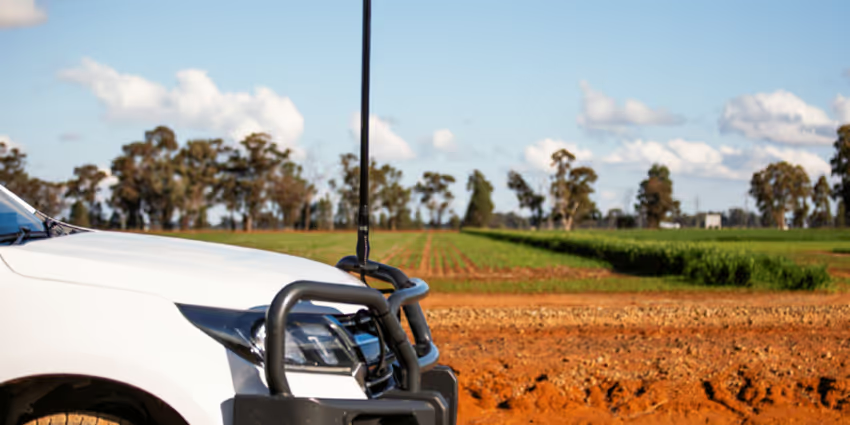
Zetifi sounds the alarm on old antennas and booster settings
WAGGA WAGGA, AUSTRALIA – Sep 10th, 2024 – Thousands of rural Australians that rely on phone signal boosters might once again find themselves without phone service if they don’t check their antennas and booster settings before the 3G network closure on 28 October, according to Wagga Wagga-based connectivity company Zetifi.
An estimated three hundred thousand Australians rely on signal repeater devices, or boosters as they’re commonly called, to extend and improve phone coverage while travelling on regional and remote roads.
While upgrading phone handsets has received the most attention in the leadup to the 3G shutdown, it’s important that users of boosters know that they may also need to update their booster settings to 4G, and check that their current antenna is compatible with the frequencies used by the 4G network.
Zetifi’s CEO Dan Winson explains: “Signal boosters are relied on more than almost any other device to improve phone coverage as people travel around rural Australia. They’re a vital tool for regional businesses and other rural residents to stay safe and productive by being able to make and receive calls in more places.
“Most people don’t give these devices much thought once they’ve been installed but it’s vital that people realise that the 3G shutdown has some consequences for their booster setup.”
Thankfully, all signal repeater devices that have been legally sold in Australia, manufactured by US company Nextivity and marketed as the CEL-FI and Telstra GO Repeater, are capable of boosting 4G once users change their settings to select 4G via the CEL-FI WAVE app.
Unfortunately, the same may not be true for the external antennas that provide the signal to these units. “Up until recently, it was very common for people to lock their devices to boost 3G and as a result, many of the antennas sold with these units were optimised to the frequencies of the 3G network, as boosting 4G was an afterthought,” said Dan.
“It’s difficult to estimate how many people could be impacted so our key message is that if you purchased your antenna more than a couple of years ago and you suddenly have less coverage come 29 October, don’t rush to blame the telcos and the 3G shutdown, as it might be that your antenna isn’t capable of receiving 4G.”
“Everyone with a booster should be checking their vehicle antenna specifications ahead of time and updating their booster settings and antenna if they need to.”
In April this year Zetifi unveiled a revolutionary new Cellular (4G/5G) Smart Antenna that is the world’s first powered vehicle antenna that can automatically switch between high and low gain modes. This innovative product provides a stronger signal for phone boosters and other cellular enabled devices by ensuring that antenna’s gain is always optimised for the surrounding terrain, without users having to manually change the antenna whip as they travel between flat and hilly areas.
For more information about Zetifi Smart Antennas, visit https://zetifi.com/smartantennas
ENDS
For media inquiries, please contact:
Robert Lansdown
Commercial Manager, Zetifi
+61 2 5973 6613 | +61 448 044 866 | rob.lansdown@zetifi.com

New Z1 range of coverage extension devices unveiled at CES 2025
A continued partnership between Zetifi and Morse Micro, and commercialisation funding from the NSW Government Physical Sciences Fund, has led to the development of a flexible new connectivity platform for remote area communications through the integration Wi-Fi HaLow, 5G RedCap, Sleepy Wi-Fi power management, and integrated Zetifi Smart Antennas.
LAS VEGAS, NV- Jan 7th, 2025 – Zetifi has partnered with fellow Australian connectivity company Morse Micro to unveil its newest Wi-Fi HaLow-powered product platform at CES 2025. Their Z1 range of products will simplify coverage extension and enable farmers to consolidate network connections by easily extending a single internet connection to multiple vehicles or fixed infrastructure.
Zetifi’s CEO, Dan Winson, explains that the availability and rapid adoption of low earth orbit satellite options led to the realisation that a new problem had emerged in rural communications, and that the solution was right in the sweet spot for Zetifi and Morse Micro.
“The emergence of low earth orbit satellite networks like Starlink has been a true game-changer, but it has already become a large monthly expense for many regional businesses.
“Even a medium size farming operation could have more than 10 pieces of machinery or sites that all need reliable internet connectivity to run their business effectively.
“As a regionally based company, we quickly learnt from our customers that they were wanting options that allowed them more flexibility and control over these mounting service costs.”
Zetifi’s approach to coverage extension is two-fold; their products allow a single internet connection to be distributed to other vehicles or sites as a Wi-Fi HaLow mesh network, and they extend cellular coverage using powerful integrated antennas that allow cellular or direct-to-handset satellite connectivity when outside of the mesh network footprint.
Morse Micro’s Wi-Fi HaLow, a new long-range Wi-Fi protocol that operates at 900MHz that offers greater range and penetration through obstacles compared to standard Wi-Fi, is a critical part of the equation.
“We set ourselves the goal of making it as easy as possible to achieve the same level of reliability and coverage for these types of operations with only two or three paid network connections. This can represent a saving of over $1,000/month so investing in affordable priced hardware to get more coverage from a service is a compelling value proposition when compared with adding more subscriptions every year,” said Dan.
Zetifi has shifted its focus from its previous X generation products (ZetiRover X and ZetiCell X) to the Z1 platform. While the X series prioritized cellular connectivity, the Z1 range integrates Wi-Fi HaLow, 5G RedCap, Wi-Fi 6, and Zetifi’s patent-pending smart antenna technology to deliver a versatile, low-cost, and easy-to-install connectivity platform.
“The possibilities opened by Starlink’s solutions made it clear we needed to re-evaluate our role in connecting farms.
“Farmers love the idea of having Starlink on their house, and lots of them will use Starlink Mini for their main tractor, but investing in affordable hardware for better coverage is far more practical for farmers than endlessly adding more subscriptions. Discontinuing the development of the ZetiRover X and ZetiCell X to make the most of this opportunity is the right decision,” said Dan.
“The new Z1 platform complements our range of Smart Antennas and aligns with the future direction of LEO satellite and direct-to-handset technologies.”
The Z1 platform will include compact solutions for vehicles and machinery, comparable in size to existing UHF or LTE antennas, as well as larger integrated options for buildings and in-field coverage. Zetifi plans to price the Z1 products at roughly half the cost of the X series.
Zetifi’s prototype ZetiRoam Z1 mesh repeater and ZetiCell Z1 are on display this week in Las Vegas at Tech West at The Venetian, Level 3, Lido 3001 as part of Morse Micro’s presence at CES 2025.
ENDS
Media contacts
Robert Lansdown, Commercial Manager, Zetifi | +61 448 044 866 | rob.lansdown@zetifi.com
Maggie Redford-Hill, Head of Communications, Morse Micro | maggie.gaston@morsemicro.com
Zetifi is an Australian wireless innovator dedicated to connecting remote and rural industries from agriculture and mining to emergency services. More than $10m of Australian Commonwealth and NSW Government funding and a $12M Series A led by Telstra and GrainCorp is supporting Zetifi’s mission to deliver cost-effective, long-range broadband solutions anywhere they’re needed.
Morse Micro develops Wi-Fi HaLow technology, enabling long-range, ultra-low-power networking for industrial IoT, logistics, and agriculture. Visit Morse Micro’s private suite near the Tech West CES floor at the Venetian Hotel. Learn how the ZetiRover and ZetiCell and Wi-Fi HaLow can modernize farming operations for a more productive and sustainable future.
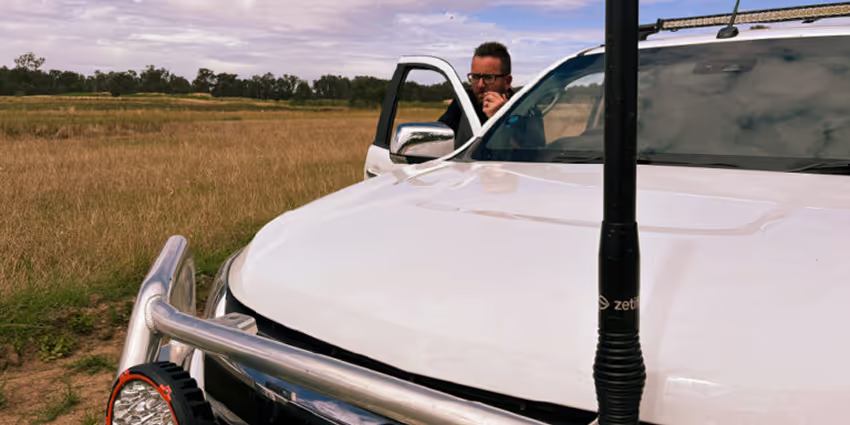
Two-in-One UHF & Cellular Combo antenna innovation changes the game for off-roaders and farmers
WAGGA WAGGA, NSW – Feb 12th, 2025 – Wagga Wagga-based connectivity pioneer Zetifi is set to release the first combination UHF and Cellular (4G/5G) Smart Antenna for vehicle bull bars, enabling consumers to run a single antenna for both their UHF CB radio and cellular devices.
Last year, Zetifi unveiled powered location-aware Smart Antennas that use an integrated GPS and miniaturised processor inside the antenna to optimise their radiation pattern between high and low gain based on location, delivering superior cellular coverage. This new product builds on that innovation by using the same rigorously tested physical design and integrated electronics platform with new antenna elements to make a significant impact in the UHF market.
A MAJOR TECHNICAL ACHIEVEMENT IN ANTENNA DESIGN
As Zetifi CEO Dan Winson explains, this product is another major technical achievement for the company and is expected to be well-received by off-roaders and workers in the agriculture, mining and essential services sectors.
Traditional wisdom in antenna design was that combining UHF and cellular antennas in a single unit was not feasible. However, as Winson points out, this challenge is precisely the kind of problem Zetifi relishes.
“Combining UHF and cellular elements in a same antenna is a significant challenge, but as we’ve shown, it’s not insurmountable. I tasked our engineers with pushing the boundaries of what we could achieve,” says Winson.
He continues, “Through countless iterations of antenna elements which we first evaluated in lab simulations at our Melbourne office before bringing them to test on the roads around our Wagga headquarters, we’ve proven it can be done.”
“We’ve achieved equivalent range to the commonly used UHF CB antennas, about 12-14 kilometres between UHF devices and possibly more in optimal conditions, plus excellent performance on 4G and 5G frequencies for cellular devices,” said Dan.
The key to their success lies in a novel approach: vertically stacking the UHF and cellular elements with a small gap between them.
“It’s well known that UHF and cellular signals can interfere with each other when placed too close. But, due to the shape of the radiation pattern they produce, we’ve managed to achieve the necessary isolation by vertically stacking the two elements within the antenna,” Winson explains.
UHF STILL A CRITICAL TOOL FOR REMOTE AREA COMMUNICATIONS
Winson also highlights that, while satellite options for remote connectivity have recently garnered more attention, UHF remains an essential communication tool for many industries and consumers in Australia.
“UHF is often underappreciated. While new satellite options are fantastic, particularly for high-speed data access, you won’t find truck drivers or serious off-roaders abandoning their UHF radios. UHF is the one trusted method they rely on to communicate with surrounding vehicles, which is crucial when navigating dusty outback roads or rugged 4WD tracks,” Winson says.
This innovative two-in-one antenna offers these UHF devotees the best of both worlds: reliable UHF communication and enhanced cellular coverage. By pairing the antenna with an in-car signal repeater, users can also stay in touch with friends, family, and colleagues that are further afield—all from a single antenna.
WORLD-FIRST INNOVATION DEVELOPED AND MANUFACTURED IN WAGGA WAGGA
Something else that distinguishes Zetifi from many other antenna manufacturers and technology companies is their regional base and manufacturing in Wagga Wagga. It’s something they’re keen to highlight as a key element to their success.
“Our products are all developed, tested, and manufactured in a regional centre, which is a big advantage as it gives us easy access to our key customers and locations where our products are needed.”
“Within ten minutes of our office, there are areas of poor cellular coverage or different terrain to test the product. Plus, there are also plenty of willing locals working in jobs that have them driving through poor coverage areas around the Riverina that are always keen to test our prototypes during development,” Winson adds.
Zetifi’s new UHF & Cellular Combo Smart Antennas will be available in black and matte black versions from Zetifi and dealers around the country for $589 incl GST from Monday 17 February.
For more information about Zetifi Combo Smart Antennas, visit https://zetifi.com/comboantennas
ENDS
Media contacts
Robert Lansdown, Commercial Manager, Zetifi | +61 448 044 866 | rob.lansdown@zetifi.com
Zetifi is an Australian wireless innovator dedicated to connecting remote and rural industries-from agriculture and mining to emergency services. More than $10m of Australian Commonwealth and NSW Government funding and a $12M Series A led by Telstra and GrainCorp is supporting Zetifi’s mission to deliver cost-effective, long-range broadband solutions anywhere they’re needed.